Cristo Obrero y Nuestra Señora de Lourdes, Estación Atlántida, Church building in Estación Atlántida, Uruguay.
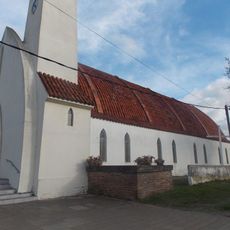
Cristo Obrero y Nuestra Señora de Lourdes is a single rectangular nave of 16 by 30 metres built entirely of exposed brick and steel reinforcement, with 7-metre conoidal side walls that rise in undulating curves to carry a roof of reinforced ceramic Gaussian vaults. A cylindrical openwork brick bell tower about 3 metres in diameter stands to the right of the facade, and a triangular prism entrance on the left of the parvis leads down to an underground baptistery lit by a central oculus.
Engineer Eladio Dieste designed and built this church between 1958 and 1960 using innovative techniques with basic materials available at the time. The work received UNESCO World Heritage recognition in 2021 for its contribution to modern architecture in Latin America.
The church was built for the stable working community of Estación Atlántida, not for the seasonal beach resort, as Dieste noted: a village of workers and peasants who supply the resort with lettuce, bricklayers and housemaids. Its full name pairs Christ the Worker with Our Lady of Lourdes, and a replica at scale was inaugurated in 1998 in Torrejón de Ardoz, Spain.
The church stands at kilometre 164 of Route 11 in Estación Atlántida. The bell tower rises about 8 metres from one side wall, slightly behind the facade, and the underground baptistery is reached from a triangular entrance on the left of the parvis, lit by a central oculus. The nave measures 16 by 30 metres, so allow time to walk its full length.
The engineer employed reinforced ceramic technology in the brick construction, allowing curved forms that would normally be difficult to achieve with such basic materials. This method was uncommon at the time and made the building a pioneer in using this approach across the region.
The community of curious travelers
AroundUs brings together thousands of curated places, local tips, and hidden gems, enriched daily by 93,311 contributors worldwide.