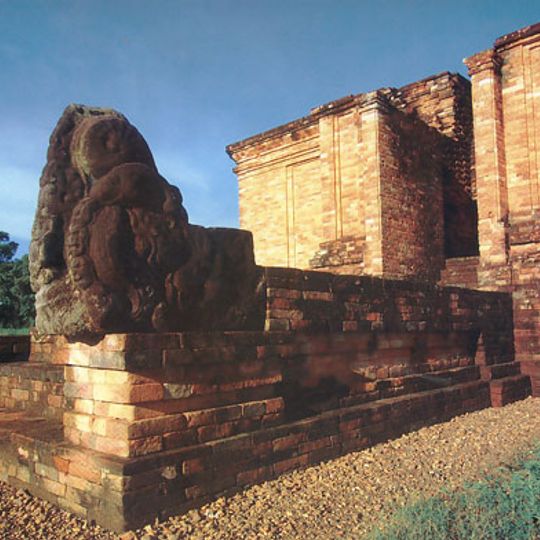
Muaro Jambi Temple Compounds, Buddhist temple complex in Jambi, Indonesia
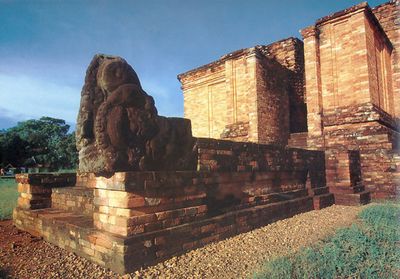
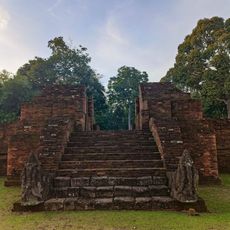
Muaro Jambi Temple Compounds is a Buddhist temple complex in Muaro Jambi Regency, Jambi province, Sumatra, Indonesia, 26 kilometres east of Jambi city. It covers about 12 square kilometres along the Batang Hari River and contains eight excavated temple sanctuaries and around 80 unexcavated mounds called menapos. The temples are built of red brick with little ornamentation; a few sculptures are kept in a small on-site museum.
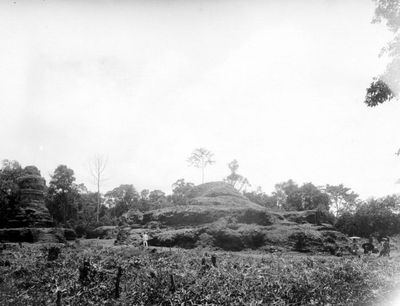
The site was built by the Melayu Kingdom, with remains dated to the 7th–12th centuries CE; some scholars suggest it may have been the first capital of Srivijaya. In 1278 the Javanese Singhasari kingdom attacked the city and captured members of the royal family. British lieutenant S.C. Crooke reported the ruins in 1824, and serious restoration began in 1975 under R. Soekmono.
The name Muaro Jambi is not a river-mouth reference; the site lies on the Batang Hari's old natural levee, and the local name for its earth-covered brick mounds is menapo. Finds of Persian, Chinese and Indian beads, a bronze gong with Chinese characters and gold-leaf Buddhist mantras show a meeting of cultures. Mahayana Tantrayana Buddhism was likely dominant, and bricks inscribed with "wajra" form a mandala.
The site is open daily from morning until evening, and visitors can rent bicycles or motorbikes to travel between the widely spaced temples. Most structures are exposed to the sun, so sun protection and water are important.
The complex also contains a small earthen mound called Bukit Sengalo, or Candi Bukit Perak, which is man-made. Among the finds are a bronze gong with Chinese characters, Buddhist mantras written on gold paper, and beads from Persia, China, and India.
The community of curious travelers
AroundUs brings together thousands of curated places, local tips, and hidden gems, enriched daily by 93,768 contributors worldwide.