Bung Karno Seclusion House, Historic exile residence in Bengkulu, Indonesia.
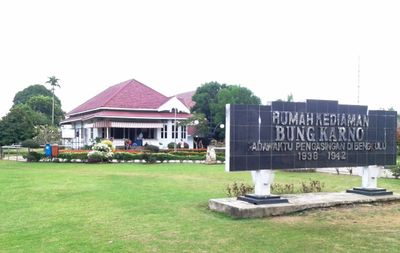
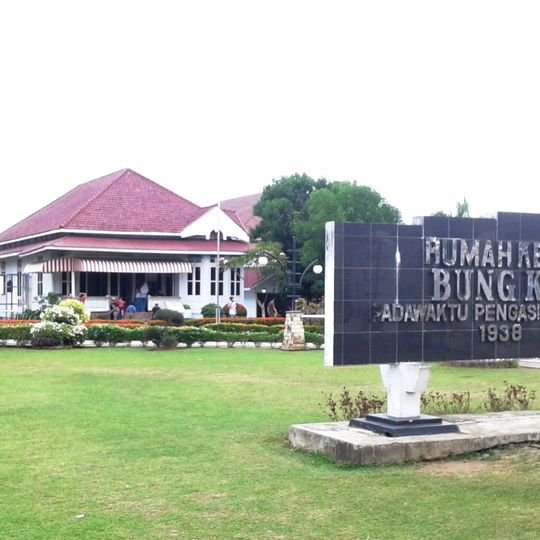
The Bung Karno Seclusion House in Bengkulu is a single-storey house with white walls, a red-tiled hipped roof and white-edged gables, set behind a lawn with a low hedge. A projecting front section has a veranda under a red-and-white striped awning on white posts. A dark sign with silver lettering marks the house and the year 1938.
Sukarno was exiled to Ende, Flores, on 14 January 1934 and held there as a political prisoner until 1938; the house he and his family occupied belonged to Abdullah Ambuwaru. In 1951 he asked that it become a museum, and on 16 May 1954 he inaugurated it as Situs Bung Karno. A total renovation began with a first stone laid on 1 May 2012 and was inaugurated by Vice President Boediono on 1 June 2013.
The building still carries traces of its political importance and shows rooms where key ideas about Indonesian freedom took shape. Visitors today see desks, bookshelves and personal objects that make the daily routine of a politician under house arrest tangible.
Guided tours explain the meaning of the rooms and exhibits, usually in Indonesian but often with English available. Exploring takes about an hour and suits visitors interested in political history.
The house in Bengkulu belonged to the Chinese trader Lion Bwe Seng and was rented by the Dutch to hold Sukarno there from 1938 to 1942. Inside are the iron bed he used with his family, a collection of mostly Dutch-language books, the uniform of the Monte Carlo theatre troupe he led, and the old bicycle he rode around Bengkulu.
The community of curious travelers
AroundUs brings together thousands of curated places, local tips, and hidden gems, enriched daily by 93,118 contributors worldwide.