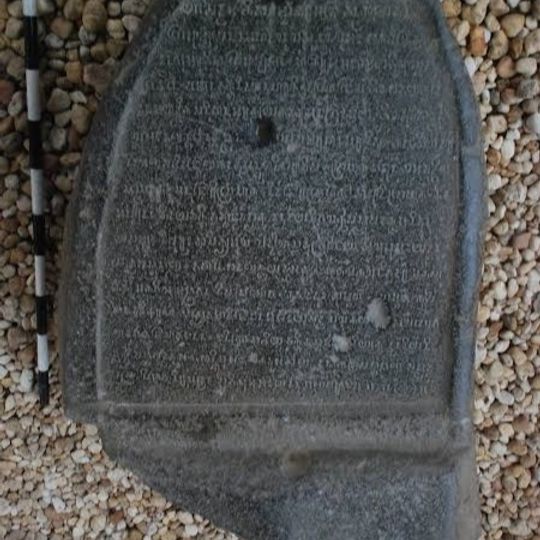
Prasasti Karang Berahi, Stone inscription in Karang Berahi, Indonesia
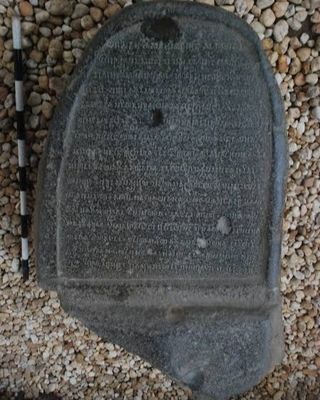
Prasasti Karang Berahi is an upright andesite slab, about 90 by 90 by 10 cm, its arched face covered in rows of Pallava script and pierced by a small hole near the upper centre. Two chalky patches mark the lower right of the inscribed area, and a plain raised band runs across the bottom above an uncarved base.
The Karang Berahi inscription dates to the 680s CE, not 904: its closing line gives Saka year 608, and it was carved as a Srivijaya army left to attack Java. It was found in 1904 by controller L.M. Berkhout on the bank of the Batang Merangin. The curse text parallels the Kota Kapur and Telaga Batu inscriptions.
The text is in Old Malay written in Pallava script, not Sanskrit. It names the deities who guard Srivijaya's province and the datu appointed by the king, and it calls down curses on rebels, poisoners and anyone who damages the stone. The same curse formula appears on the Kota Kapur and Telaga Batu inscriptions.
The stone stands in Karang Berahi village, Pamenang district, Merangin Regency, Jambi, on the bank of the Batang Merangin river where it was found in 1904. It is an upright slab about 90 cm high, 90 cm wide and 10 cm thick, set on pale pebbles; a striped measuring pole beside it marks the spot. The carved face is best read in raking morning or late-afternoon light, when the Pallava characters stand out from the dark andesite.
The text ends with a date in the Saka calendar: year 608, first day of the bright half of Waisakha, when the curse was spoken. Carving began as the Srivijaya army set out to attack the land of Java, which had not submitted to Srivijaya.
The community of curious travelers
AroundUs brings together thousands of curated places, local tips, and hidden gems, enriched daily by 93,468 contributors worldwide.