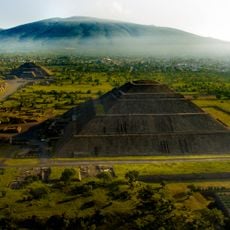
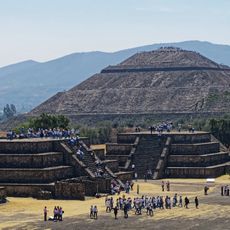
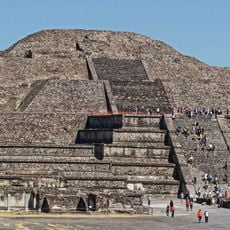
Temple of the Feathered Serpent, Teotihuacan, Pre-Columbian step pyramid in Teotihuacan, Mexico.
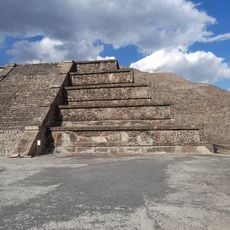
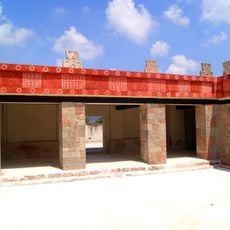
The Temple of the Feathered Serpent is a six-level talud-tablero step pyramid at the southern end of the Avenue of the Dead, within the Ciudadela complex. Its west facade carries carved stone panels of a goggled face with a feathered headdress, alternating with protruding serpent heads, above bas-reliefs of the full feathered serpent in profile. A fourth-century Adosada platform stands in front, partly hiding the pyramid.
This structure was built in the early centuries after Christ and dedicated to the deity that later became central to Aztec religion. Its architectural style and symbolic imagery influenced religious concepts across Mesoamerica for centuries to come.
The feathered serpent heads on the facade alternate with those of another snake-like creature, often identified as Tlaloc; Mary Ellen Miller and Karl Taube read them as a war serpent, Michael D. Coe as a fire serpent wearing the Teotihuacan war symbol. Obsidian was set into the eyes so they glimmered in the light, and the pyramid was once painted blue with carved sea shells.
The temple sits in the southern section of the archaeological site and is surrounded by an open plaza where visitors can view the structure from multiple angles. Access is straightforward, as the grounds are well-marked with paths leading around all major structures.
A tunnel system beneath the temple was discovered containing numerous ritual offerings, including seashells, pottery, and carved greenstone figures. These hidden chambers reveal how the builders understood sacred spaces and divine offerings.
The community of curious travelers
AroundUs brings together thousands of curated places, local tips, and hidden gems, enriched daily by 93,394 contributors worldwide.