Teotihuacan, Archaeological site in San Juan Teotihuacán, State of Mexico, Mexico
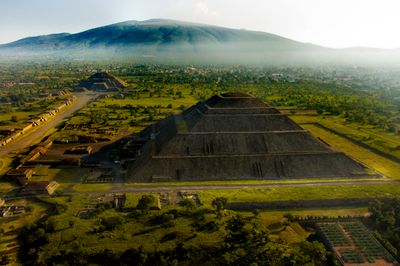
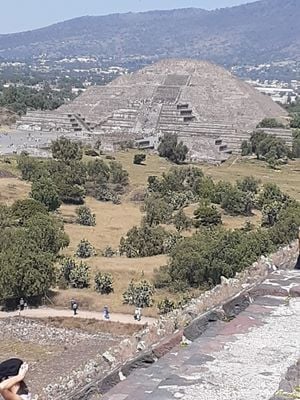
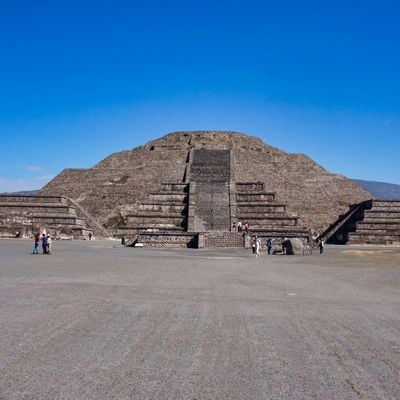
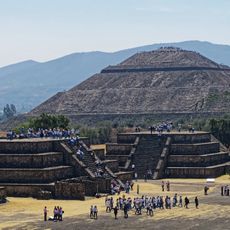
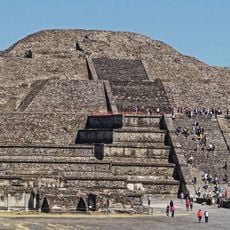
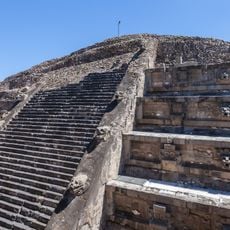
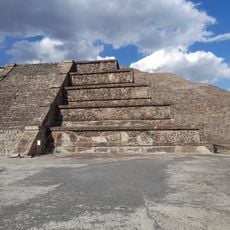
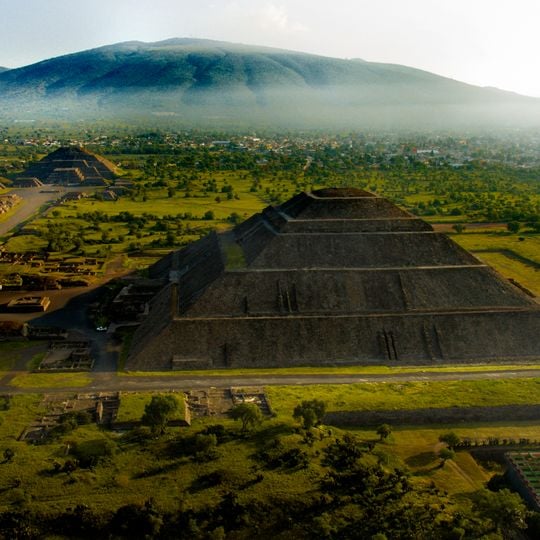
Teotihuacan is an archaeological zone in the State of Mexico, about 40 kilometers northeast of Mexico City. Its main axis is the Avenue of the Dead, a north-south thoroughfare lined by the Sun Pyramid, the Moon Pyramid at the northern end, and the Ciudadela with the Temple of Quetzalcoatl. The Sun Pyramid is a stepped structure of rough grey stone rising in four tiers to a flattened top, with three vertical channels on its lower front; a smaller stepped pyramid stands in the distance.
Teotihuacan began around 100 BCE as a village and grew into a city that, at its height between 200 and 600/650 CE, covered about 20 square kilometres and housed 100,000 to 200,000 people. Its major monuments were sacked and burned around 550 CE, and the city declined between 600 and 650 CE amid political instability and climate change.
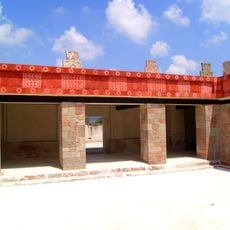
Wall paintings inside the buildings show religious processions, trade goods, and figures from myth that reveal a wide network of beliefs and exchange throughout Mesoamerica. People from different origins lived in ethnically organized neighborhoods, forming a mixed population where workshops for obsidian and ceramics produced goods shipped to distant regions.
The site is managed daily by the Instituto Nacional de Antropología e Historia from 9 AM to 5 PM, with guided tours available in multiple languages. Visitors should bring sun protection and water as most of the terrain remains exposed, and the onsite museum displays artifacts recovered from the excavations.
The name Teotihuacan was given by the Aztecs centuries after the city fell around 550 CE; its original name is unknown, though Maya texts call it puh, "Place of Reeds". In 2018 archaeologist Verónica Ortega proposed the city was actually called Teohuacan, "City of the Sun".
The community of curious travelers
AroundUs brings together thousands of curated places, local tips, and hidden gems, enriched daily by 92,163 contributors worldwide.