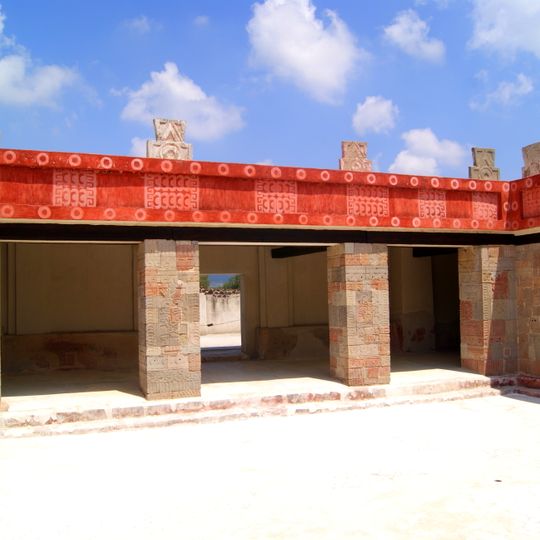
Quetzalpapálotl, Archaeological palace in Teotihuacan, Mexico
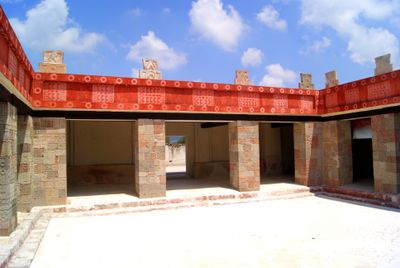
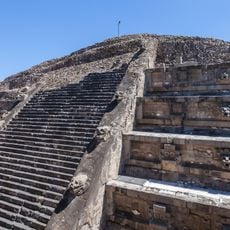
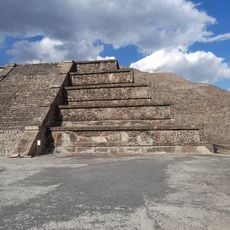
The Quetzalpapálotl is a ruined palace complex in Teotihuacan whose main entrance faces the Avenue of the Dead, southwest of the Pyramid of the Moon. Its central courtyard is ringed by porticoes whose stone columns are carved with butterflies and quetzal feathers, once painted in colour. Adjacent structures keep murals, among them the Palace of the Jaguars.
The palace complex was built between 450 and 500 AD, constructed over earlier structures dating from 250 to 300 AD within ancient Teotihuacan. This layering demonstrates how the site was repeatedly modified and expanded throughout multiple centuries.
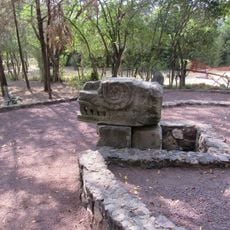
The name combines Nahuatl words 'quetzalli' for precious feathers and 'papalotl' for butterflies, both creatures that appear carved throughout the stone walls. These carvings show how the ancient inhabitants embedded mythological beings into the fabric of their everyday spaces.
The main entrance opens onto the Avenue of the Dead, southwest of the Pyramid of the Moon. The complex was rehabilitated between 2009 and 2011 by the Instituto Nacional de Antropología e Historia, so the courtyard and its porticoes are the restored parts to look at. The Temple of the Feathered Conches lies buried beneath the palace, so plan on viewing the complex from the courtyard level.
The subterranean Temple of the Feathered Conches displays paintings of green birds and water streams alongside decorative shells adorning the columns. This combination of water, birds, and ocean symbols merges several sacred elements within one underground space.
The community of curious travelers
AroundUs brings together thousands of curated places, local tips, and hidden gems, enriched daily by 93,778 contributors worldwide.