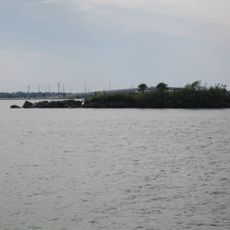
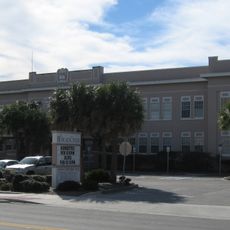
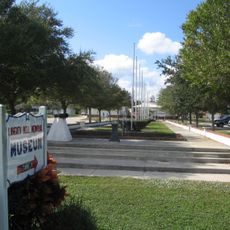
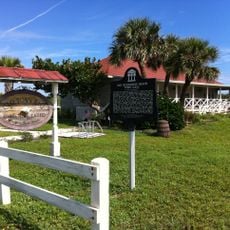
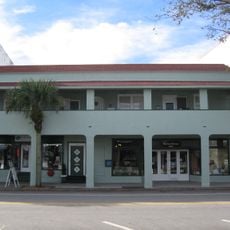
Melbourne Bone Bed, Paleontological site at Crane Creek in Melbourne, Florida, United States.
The Melbourne Bone Bed is a fossil site in Melbourne, Florida, where a layer of brown sand holds the remains of extinct animals from thousands of years ago. The site spans multiple locations across the area, with bones and teeth scattered through different sections.
C. P. Singleton found mammoth bones on his Crane Creek property and brought Amherst College paleontologist Frederick B. Loomis to excavate. Loomis also found a second elephant with a rough flint instrument among its ribs. In 1925 work moved to the Melbourne golf course, where a crushed human skull was found with a horse tooth; James Gidley of the Smithsonian joined in 1926 and collected until 1929.
The skull found at the golf course in 1925 became known as the Melbourne Man after a 30-year debate between geologists and archaeologists. It was exhibited at the Paleontological Society of America meeting that year. Consensus now dates it as early as 10,000 BC, confirming that Native Americans coexisted with Pleistocene mammals there.
The site is not easily accessible and most remains are buried or held in private collections. Before visiting, you should research current conditions, as it is primarily a scientific location rather than a public attraction.
A carved piece of ivory was found alongside human bones during a 1925 excavation, raising questions about tool-using people living at that time. This discovery remains one of the site's most puzzling aspects and continues to be debated by researchers.
The community of curious travelers
AroundUs brings together thousands of curated places, local tips, and hidden gems, enriched daily by 94,348 contributors worldwide.