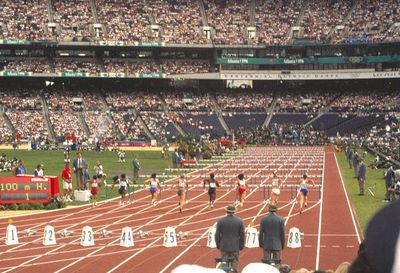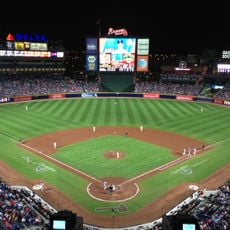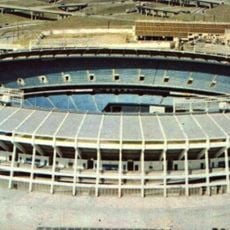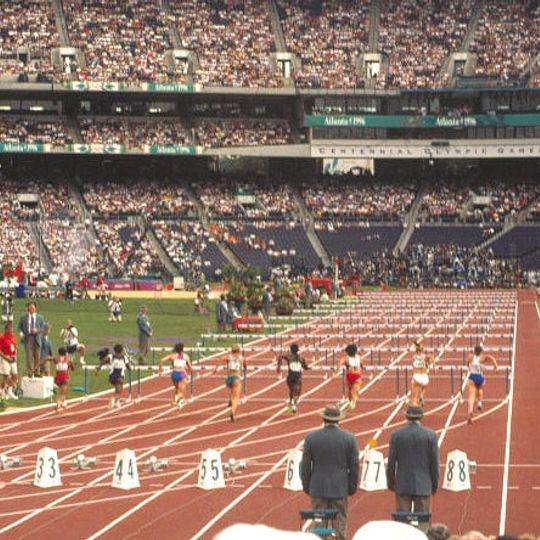
Centennial Olympic Stadium, Olympic stadium in Atlanta, United States.
Centennial Olympic Stadium was built with 85,000 seats for the 1996 Atlanta Olympics, its southwest corner holding four seating tiers, luxury boxes, a street-facing facade and a roof, while the north half used a simpler two-tier layout. The seats stood apart from the oval running track, and the field of play, including foul territory, was larger than in most MLB parks built after 1990. After the Games the north half was demolished, cutting capacity to 49,000.
Atlanta was chosen as the 1996 host city on 18 September 1990 in Tokyo, beating Athens for the centenary Games. Construction began in 1993 on the parking lot of Atlanta–Fulton County Stadium, and the 85,000-seat venue was ready for the July 1996 opening ceremony. It was designed so it would not become a white elephant: after the Paralympics the track was moved to Clark Atlanta University, the north half was demolished and the rebuilt 49,000-seat Turner Field opened in 1997 for the Braves.
The name Centennial Olympic Stadium marked the 1996 Games' coincidence with the centenary of the modern Olympics, for which Atlanta beat Athens in the 1990 host vote. The Atlanta Track Club's annual Father's Day four-mile road race still finishes inside the stadium near the old Olympic finish line on the warning track.
The stadium stands on the site of the former parking lot of Atlanta–Fulton County Stadium, whose own site became a parking lot for the rebuilt venue. The annual Father's Day four-mile road race of the Atlanta Track Club finishes inside the stadium, near the warning track where the Olympic finish line was.
The building went through two major conversions, becoming first a baseball stadium and later a college football venue. These transformations show how an Olympic legacy was repurposed for modern sports needs.
The community of curious travelers
AroundUs brings together thousands of curated places, local tips, and hidden gems, enriched daily by 92,988 contributors worldwide.