Interstate Bridge, Vertical-lift bridge in Portland, United States
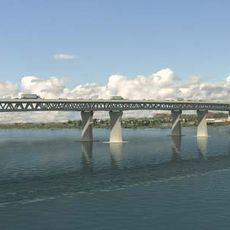
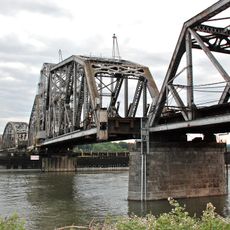
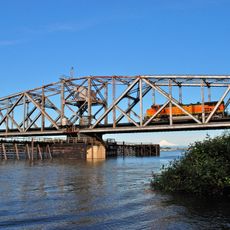
The Interstate Bridge is a twin steel structure over the Columbia River between Portland and Vancouver. The center segments can rise vertically to let ships pass underneath.
Construction of the first Interstate Bridge began in March 1915, and the structure opened on February 14, 1917, at a cost of $1.75 million, shared by Clark and Multnomah counties. It was the first automobile bridge across the Columbia between Washington and Oregon, after the Wenatchee Bridge of 1908. A parallel span, built from summer 1956, opened on July 1, 1958, at a cost of $14.5 million; the old bridge was then closed for rebuilding with a matching humpback section, and both spans opened together on January 8, 1960.
The bridge's name simply describes its role linking two states, chosen decades before the Interstate Highway System existed. Electric streetcars crossed from opening day in 1917 until September 3, 1940, on dual-gauge track serving Portland's 3 ft 6 in cars and Vancouver's standard gauge. It joined Interstate 5 in 1957, after carrying U.S. Route 99 from 1926.
Drivers crossing the span can expect delays when the lift sections go up for ships. Traffic stops briefly during these moments until the passage is clear again.
The lift span rises 136 ft (41 m) to give ships 176 ft (53.6 m) of clearance, and the towers reach 190 ft (57.9 m) above the roadway. The bridge was listed on the National Register of Historic Places in 1982 as the Portland–Vancouver Highway Bridge.
The community of curious travelers
AroundUs brings together thousands of curated places, local tips, and hidden gems, enriched daily by 92,787 contributors worldwide.