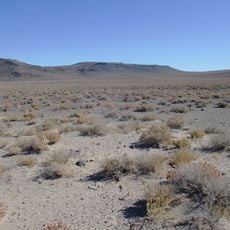
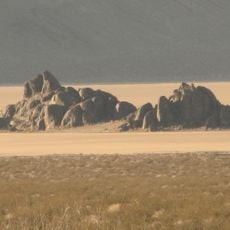
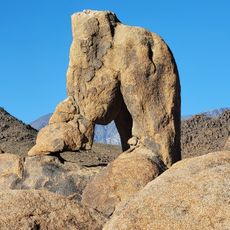
Sailing stones, Geological phenomenon at Racetrack Playa in Death Valley National Park, US.
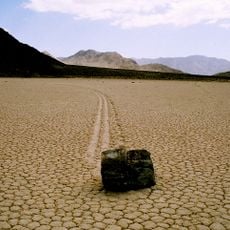
Sailing Stones are angular blocks of black dolomite and tan syenite, mostly 15 to 46 cm across, scattered on the cracked clay floor of Racetrack Playa in Death Valley National Park, California. Each stone sits at the end of a shallow groove 8 to 30 cm wide and under 2.5 cm deep, cut into the pale surface.
The first documented account dates to 1915, when prospector Joseph Crook of Fallon, Nevada, visited Racetrack Playa. Geologists Jim McAllister and Allen Agnew mapped the bedrock in 1948 and published the earliest report on the sliding rocks. In 1968 Bob Sharp and Dwight Carey began a seven-year monitoring program, labeling 30 stones with fresh tracks and staking their positions.
The stones carry informal names given by researchers: Karen, the heaviest moved at about 350 kg, Mary Ann, which slid 64.5 m in one winter, and Nancy, 6.5 cm across, which covered 262 m in total. Visitors can still see the numbered stakes and furrows left by the 1968 monitoring program.
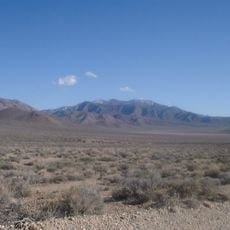
The moving rocks sit about two miles south of the Grandstand parking area on the playa and can be reached on foot across the flat desert floor. The walk crosses hard clay with no shade and can become very tiring in summer heat.
The rocks move only during a few winter days when thin ice forms on shallow water puddles and wind pushes the ice sheets across the wet clay. Some trails stretch over 800 feet (250 meters) and remain visible for years until new rainfall erases them.
The community of curious travelers
AroundUs brings together thousands of curated places, local tips, and hidden gems, enriched daily by 92,308 contributors worldwide.