Racetrack Playa, Dry lake in Death Valley National Park, United States
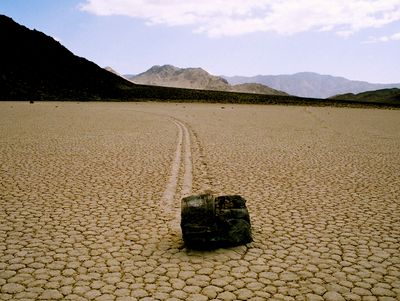
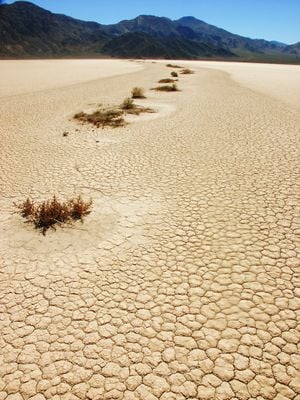
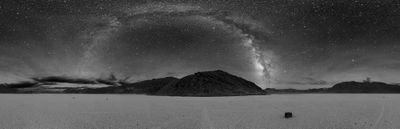
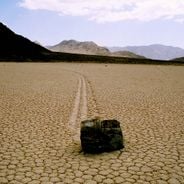
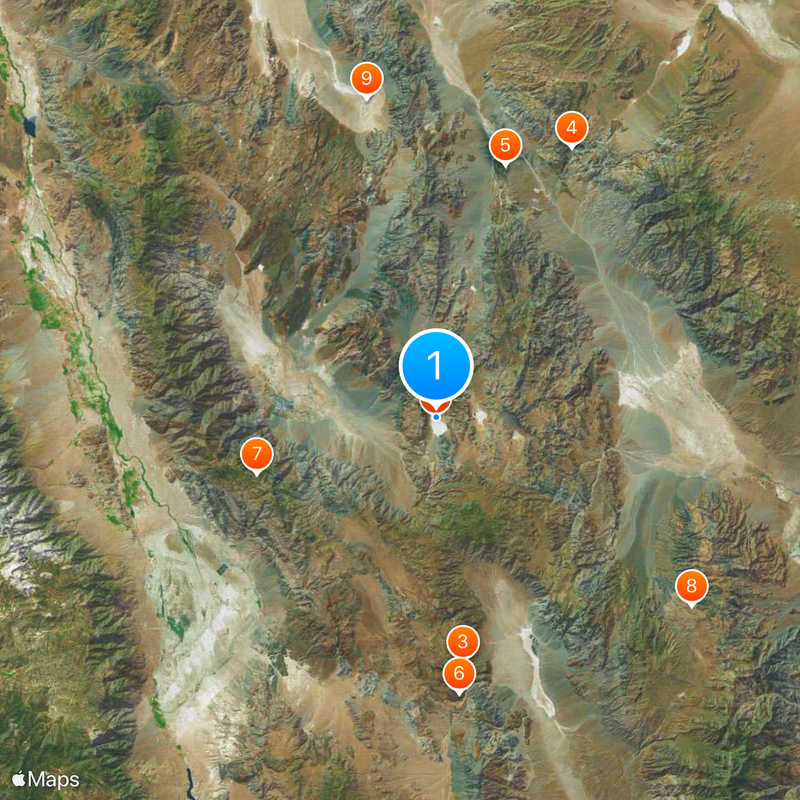
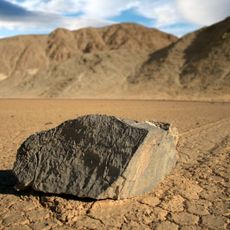
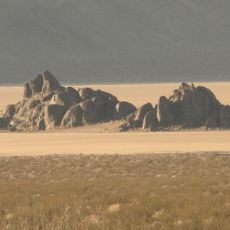
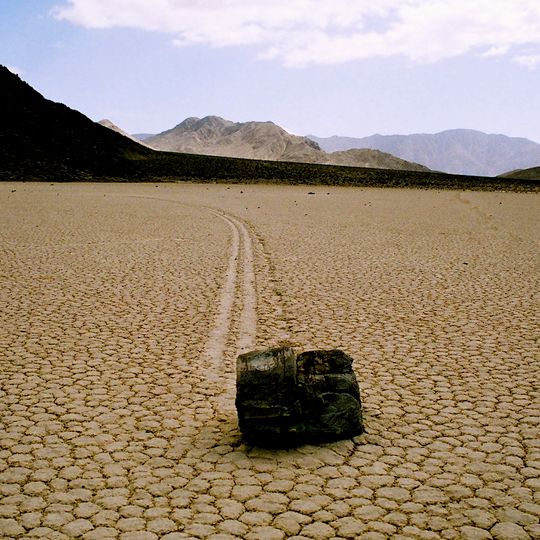
The dry lakebed extends 4.5 kilometers in length and 2 kilometers in width, surrounded by mountain ranges to the east and west. The surface consists of cracked clay forming characteristic polygonal patterns. Dark rock fragments lie scattered across the pale expanse, some leaving clearly visible trails in the sediment. The setting displays typical features of a closed basin with no water drainage.
Scientists have documented stone movement patterns across the surface since 1948, developing numerous theories about transport mechanisms. For decades the phenomenon remained unexplained until researchers in 2014 used camera recordings and GPS sensors to prove that thin ice sheets move rocks under specific weather conditions. This discovery ended speculation circulating since the 1950s. The site gained international scientific importance through these findings.
This geological formation functions as a natural laboratory where researchers investigate interactions between wind forces, ice formation, and stone displacement. The remote location and undisturbed surface allow scientific experiments under nearly pristine conditions. The area attracts scientists from various disciplines seeking insights into physical processes in extreme environments. Research findings contribute to understanding similar phenomena on other planets.
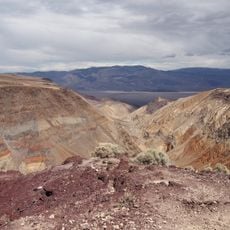
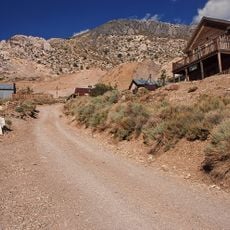
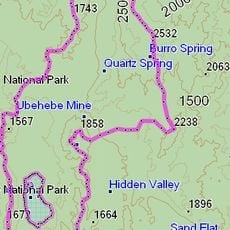
Visitors need high-clearance vehicles since access requires navigating 27 miles (43 kilometers) of unpaved roads from Ubehebe Crater. The route demands several hours of driving time and may become impassable after rainfall. No facilities or shade exist on site, so guests should bring sufficient water, food, and sun protection. The best visiting period falls between November and April when temperatures are more moderate.
The surface displays remarkable flatness with only 1.5 inches (3.8 centimeters) of elevation difference between northern and southern ends across the entire 4.5 kilometers. This extreme levelness makes it one of the flattest natural surfaces in North America. Geologists use this property as a reference plane for measuring instruments. The minimal slope allows even light wind forces to move frozen sediment layers with stones resting upon them.
The community of curious travelers
AroundUs brings together thousands of curated places, local tips, and hidden gems, enriched daily by 90,737 contributors worldwide.