Keyhole Sink, Canyon with petroglyphs in Williams, Arizona.
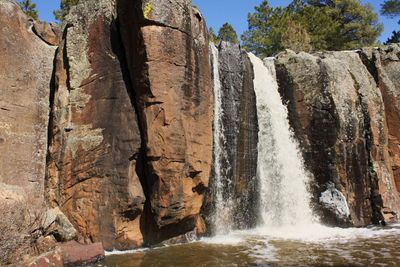
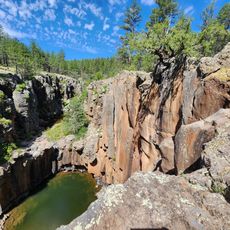
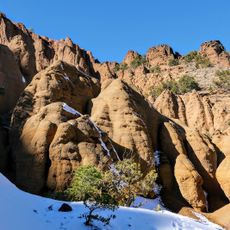
Keyhole Sink is a keyhole-shaped canyon a few miles east of Williams, Arizona, in Kaibab National Forest. Its walls are stacked, blocky volcanic basalt in reddish brown, tan and dark grey, with deep vertical fissures. A narrow seasonal waterfall pours from the top edge into a brownish pool at the base, and petroglyphs carved by the Cohonina people cover parts of the rock.
Keyhole Sink, formerly called Box Canyon, lies a few miles east of Williams off Route 66 in Kaibab National Forest. Its petroglyphs, carved into volcanic basalt between 700 and 1100 CE, show snakes, lizards, deer and amorphous images. In August 2010 vandals painted large letters on them in silvery white paint; the carvings were later restored, though the damage remains visible.
The Cohonina carved the petroglyphs into volcanic basalt between 700 and 1100 CE, leaving images of snakes, lizards, deer and amorphous forms. Archaeology indicates few people lived here; the canyon served as a sacred rest stop for hunters and a place for clan initiations. Remnants of pit house foundations lie within a fifteen-mile radius.
Visitors can reach this canyon via a one-mile trail from the Oak Hill Snow Play parking area, located across from the trailhead on Route 66. The path is most accessible during drier months, and hikers should watch for slippery rock surfaces, especially after rainfall.
In August 2010, vandals painted large letters on the petroglyphs with silvery white paint. The carvings were restored afterwards, but the damage is still visible on the weathered basalt. The site lies a few miles east of Williams off Route 66, in Kaibab National Forest.
The community of curious travelers
AroundUs brings together thousands of curated places, local tips, and hidden gems, enriched daily by 95,025 contributors worldwide.