Castle Rock, Natural butte in Castle Rock, Colorado.
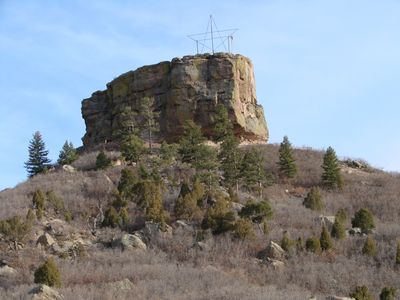
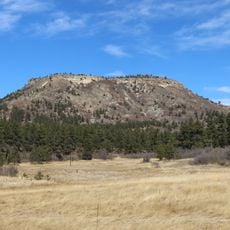
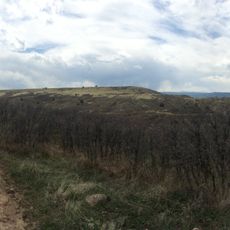
Castle Rock is a butte in the Colorado Piedmont, a mesa whose caprock is rhyolite, a volcanic rock resistant to erosion. About 58 million years ago an eruption covered the area with 20 feet (6.1 m) of rhyolite; later flooding and erosion left the butte-shaped mesa. It rises 77 metres above the surrounding terrain and stands 1,995 metres above sea level.
The butte's rhyolite caprock formed about 58 million years ago when a volcanic eruption blanketed the area with 20 feet of rhyolite; later flooding and erosion carved the mesa shape. The town of Castle Rock, founded in the 1870s, took its name from the landmark.
The butte gave the town of Castle Rock its name, and the town incorporated in 1881. Visitors can see the formation from Front Street and Canyon Drive, where the Rock Park trailhead begins. The mesa's flat top and steep sides are visible from much of the town center.
The butte is easily visible from town and serves as a helpful reference point for getting around the area. The site becomes particularly notable during the holiday season when a large electric star is lit on top, making it stand out even more against the sky.
The butte's rhyolite caprock formed from a volcanic eruption about 58 million years ago, when roughly 20 feet of rhyolite covered the surrounding area. Flooding and erosion later left the mesa shape seen today. The town of Castle Rock, about 0.74 km away, takes its name from the landmark.
The community of curious travelers
AroundUs brings together thousands of curated places, local tips, and hidden gems, enriched daily by 94,546 contributors worldwide.