Hell's Half Acre Lava Field, Lava field in Bingham County, US.
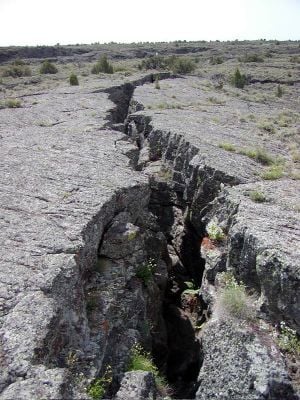
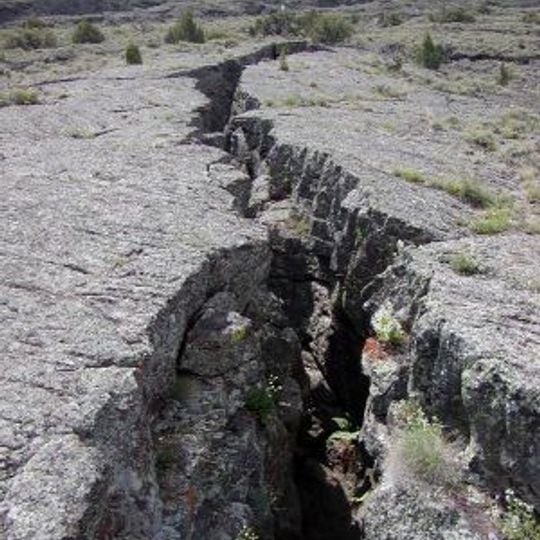
Hell's Half Acre Lava Field is a basaltic plain covering about 150 square miles on the Snake River Plain in Bingham and Bonneville counties, Idaho. Its surface is cracked and blocky, split by a deep fissure with jagged walls of grey stone tinted reddish and greenish inside. Near the summit lie a depression from a former lava lake, ten circular pits and two large lava tubes.
Geologists estimate the lava field formed around 3250 BC from the Lava Ridge–Hell's Half Acre fissure vent, with at least eight pāhoehoe lava lobes. Fur traders in the early 19th century applied the name, a common expression for rough land. Benjamin Bonneville, financed by John Jacob Astor, saw the site in 1833; Washington Irving used his journals for a book describing chasms four to ten feet wide.
The National Park Service designated the northwestern portion as a National Natural Landmark in 1976, recognizing its geological importance.
Interstate 15 crosses the southeast corner of the lava field, and the Hell's Half Acre rest area on I-15 gives access to a north parking lot with a 0.75-mile trail and educational signs. A south parking lot leads to a 1-mile trail with signs, a gazebo and an overlook at its midpoint, plus a 0.25-mile paved loop for wheelchair users. Blue flags mark a 0.5-mile trail of about 30 minutes; red flags mark a 4.5-mile trail to the central vent that takes a full day. All trails close in winter.
Washington Irving, drawing on Benjamin Bonneville's journals, wrote that a stone dropped into one of the chasms reverberated against the sides for an apparently great depth. Bonneville tried to sound the openings in 1833 but got no satisfactory result. The fissure vent feeding the field may run 11.8 miles (19 km) long, partly buried under later lava.
The community of curious travelers
AroundUs brings together thousands of curated places, local tips, and hidden gems, enriched daily by 93,783 contributors worldwide.