Lougheed House, National historic mansion in Beltline district, Calgary, Canada
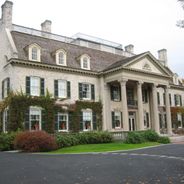
Lougheed House is a 1,300-square-metre sandstone mansion designed by James C. Bowes in a High Victorian style with Queen Anne Revival influences. Its rough-faced sandstone exterior, asymmetrical massing and corner towers are visible from the street, while the interior of the 48-room house is decorated with Spanish mahogany, Italian marble, stained glass and hand-painted images of Alberta flora and fauna.
James Alexander Lougheed, appointed to the Senate of Canada in 1889, commissioned the mansion for his wife Isabella Hardisty Lougheed and their sons Clarence and Norman. The house was enlarged in 1907 as the family grew to six children. The estate owned the property until 1934, when unpaid property taxes led the City of Calgary to take possession; Isabella lived there until her death in 1936.
The rooms display hand-painted illustrations of Alberta's native plants and animals, reflecting the natural world of the prairie. These artworks show how the household connected with the surrounding landscape.
The house and Beaulieu Gardens sit in the Beltline district, run by the Lougheed House Conservation Society, which began restoring the property in 2000. The gardens, part of the original formal grounds, are operated as a municipal park by the City of Calgary Parks Department and can be walked through separately from the house.
During World War II, the house was converted into barracks for the Canadian Women's Army Corps and later served as a Red Cross blood donation clinic. This dual use shows how the residence supported the local community during critical times.
The community of curious travelers
AroundUs brings together thousands of curated places, local tips, and hidden gems, enriched daily by 92,634 contributors worldwide.