Mummy Cave, Archaeological site in Park County, Wyoming, US
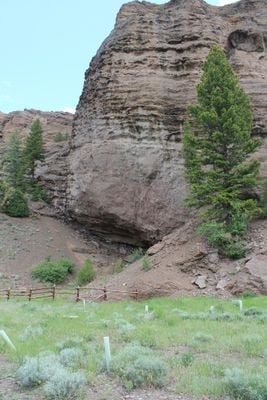
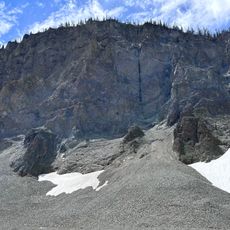
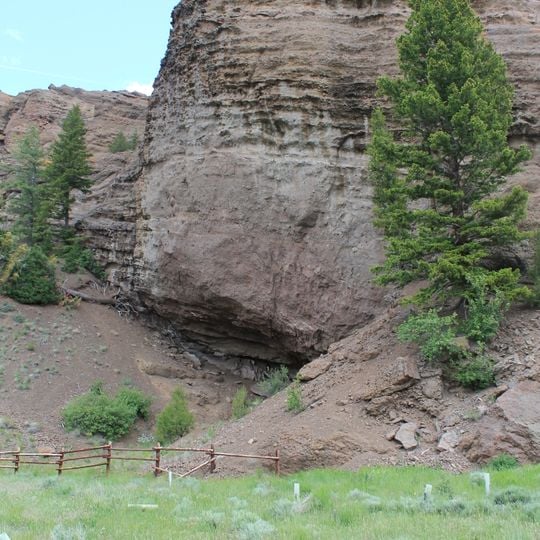
Mummy Cave is a broad, shallow alcove in a vertical cliff of Tertiary volcanic ash and rock fragments on the left bank of the North Fork of the Shoshone River. At its mouth the shelter is about 150 feet (46 m) wide and reaches about 40 feet (12 m) into the cliff, with its roof roughly 50 feet (15 m) above the river. A dark recess opens above a steep slope of loose dirt and rock, and conifers grow against the right side of the face.
Excavations between 1963 and 1965 uncovered 38 distinct layers of occupation at the site. These layers span from the Paleoindian period through the late Prehistoric era.
The name refers to "Mummy Joe," the mummified remains of an inhabitant buried in the alcove and dated to about AD 800. The site lies on the left bank of the North Fork of the Shoshone River, beside a small stream and opposite the mouth of Blackwater Creek. Its 38 occupation levels record at least seasonal, annual use from the Paleoindian period to the late Prehistoric period.
The shelter sits on the left bank of the North Fork of the Shoshone River, beside U.S. Routes 14/16/20 near the eastern entrance to Yellowstone National Park. The alcove opens above a steep slope of loose dirt and rock, so footing is uneven; a wooden rail fence runs along the grassy ground in front. The site is in Shoshone National Forest at 6,310 feet (1,920 m).
The shelter's exceptionally dry conditions have preserved organic materials like hides, feathers, and wood across thousands of years. This level of preservation is quite rare and makes the archaeological record here unusually detailed.
The community of curious travelers
AroundUs brings together thousands of curated places, local tips, and hidden gems, enriched daily by 93,930 contributors worldwide.