Laguna Azul, Geological provincial reserve in Santa Cruz, Argentina.
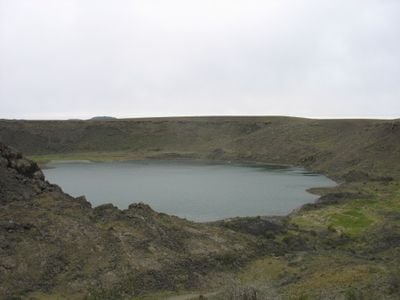
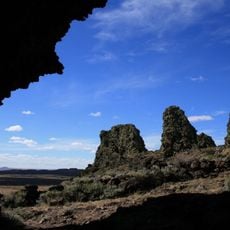
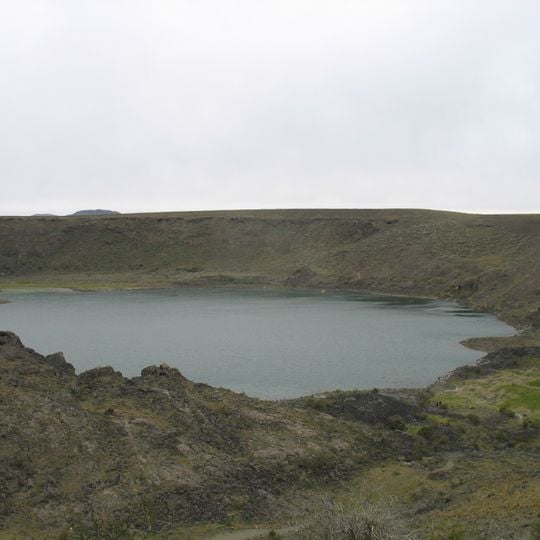
Laguna Azul fills the crater of an inactive volcano in the Pali Aike volcanic field, on the Patagonian steppe. The water is opaque grey-green, rippled across a roughly oval surface, and reaches 295 m deep with a diameter of 560 m. Dark brown and grey boulders and dry low vegetation border it, with greener grass along the far right shore. The crater rim stands at 200 m above sea level, the water surface below 140 m.
The crater formed in the middle of the Holocene, within a volcanic field of Pali Aike whose igneous activity unfolded over the last million years. Its final eruptions took place slightly less than 10,000 years ago. On 24 November 2005, Santa Cruz law no. 2828 created the 60-hectare Laguna Azul geological reserve.
The name Laguna Azul comes from the water's intense blue colour, caused by the absence of suspended material. The crater cliffs are nesting sites for bandurrias, the South American ibis, and the surrounding steppe concentrates guanacos, ñandúes and European hares. Santa Cruz law 2828 of 24 November 2005 created the 60-hectare geological reserve, whose rules remain undefined and disputed.
The reserve lies in the Pali Aike volcanic field, 62 km south of Río Gallegos in Santa Cruz Province; a French source gives 56 km to the southwest. The crater rim stands at 200 m above sea level, the water surface below 140 m, and the inner slopes are steep basalt cliffs. The protected area covers 60 hectares, and its regulations are not clearly defined.
The lake's sediments provide scientists with information about climate patterns over long periods. The intense blue color comes from the water containing very few suspended particles.
The community of curious travelers
AroundUs brings together thousands of curated places, local tips, and hidden gems, enriched daily by 93,053 contributors worldwide.