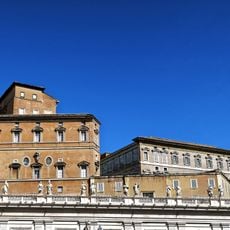
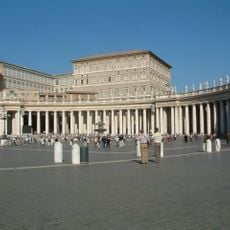
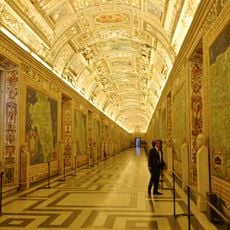
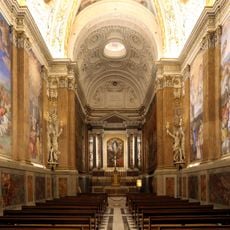
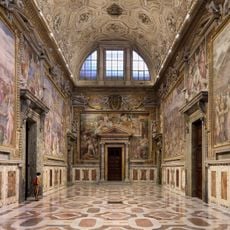
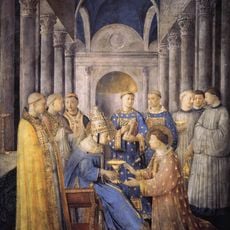
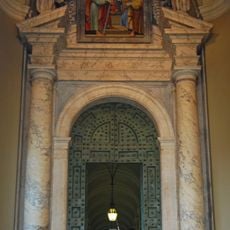
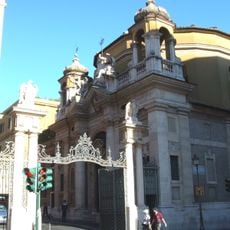
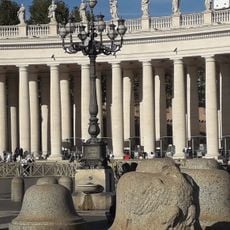
Vatican loggias, Renaissance loggia in Apostolic Palace, Vatican City.
The Vatican loggias are a series of columned halls on the second floor of the Apostolic Palace containing thirteen vaulted bays completely covered in fresco paintings. Each bay features detailed biblical scenes with ornamental details that extend across all the vaults.
Bramante began the loggias in 1512 as a facade for the old palace of Nicholas III, under Julius II, with work continuing under Leo X and Raphael as superintendent after Bramante's death. The second-floor loggia was decorated first, in 1518-1519, because it adjoined the papal apartment. The third loggia was frescoed after 1550 by Giovanni da Udine.
The decoration avoids large narrative frescoes: on a white background, grotesques imitate ancient Roman painting rediscovered in the Domus Aurea, with painted sculptures in niches and small biblical scenes. Raphael's workshop used this repertoire, later copied by artists across Europe. The third-floor loggia was decorated after 1550 by Giovanni da Udine.
The loggias are not on the standard Vatican Museums route; they form part of the ceremonial route reserved for visiting dignitaries and diplomats. Ordinary visitors should not count on entering them during a regular visit.
Between 1787 and 1792 Giacomo Quarenghi built a full-scale copy of the loggias, called the Raphael Loggias, inside the Large Hermitage in Saint Petersburg. It reproduces the grotesque decoration of the Vatican corridor for the Russian imperial court.
The community of curious travelers
AroundUs brings together thousands of curated places, local tips, and hidden gems, enriched daily by 94,048 contributors worldwide.