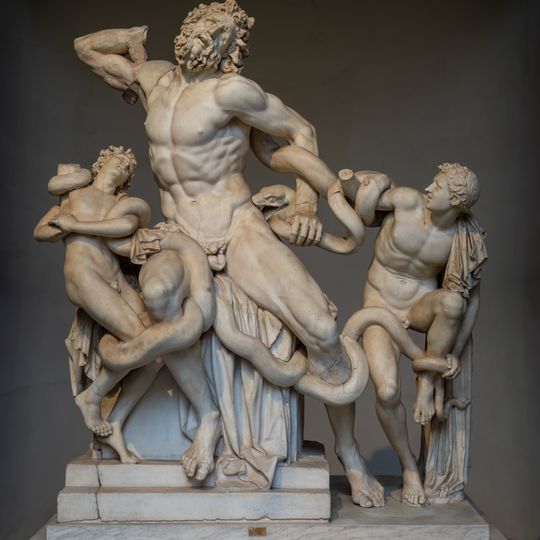
Laocoön and His Sons, Hellenistic marble sculpture group in Vatican Museums, Vatican City
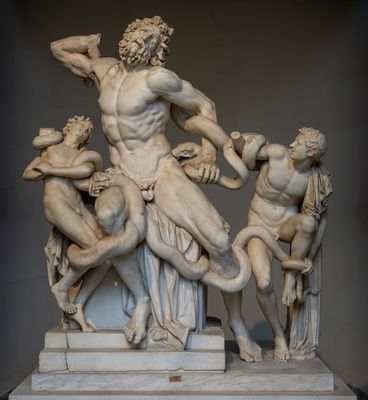
Laocoön and His Sons is a marble group in the Pio-Clementino Museum showing three male figures and two coiled sea serpents. The bodies twist in a spiral around each other, with arms and legs crossing and faces expressing pain.
Workers discovered the group in 1506 on the Oppian Hill near the Domus Aurea and Michelangelo was present during the uncovering. Pope Julius II had the work brought to the Vatican shortly after, where it has remained ever since.
The name Laocoön comes from Greek myths and his depiction shows a moment of desperate fear of death that viewers can still relate to today. The three figures struggle together against the serpents and form a tight group that expresses both physical suffering and family bond at the same time.
The sculpture stands in its own room in the Pio-Clementino Museum and is accessible from all sides. Visitors can approach closely and view the surface from different angles to see details of the musculature and facial expressions.
When the group was found in 1506, both Laocoön and his younger son lacked the right arm. A terracotta replacement by Giovanni Angelo Montorsoli showed the arm stretched outward, and Winckelmann defended keeping it despite knowing the original position differed. Agostino Cornacchini renewed the arms between 1725 and 1727.
The community of curious travelers
AroundUs brings together thousands of curated places, local tips, and hidden gems, enriched daily by 92,267 contributors worldwide.