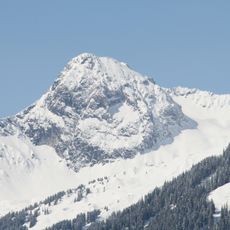
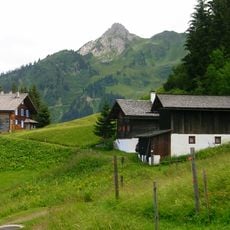
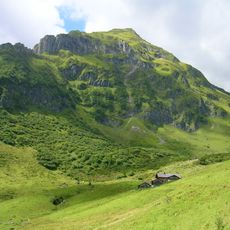
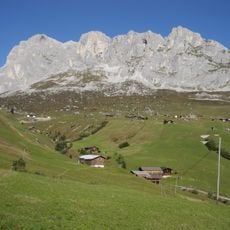
Drusenfluh, Mountain summit in Rätikon range, Austria and Switzerland
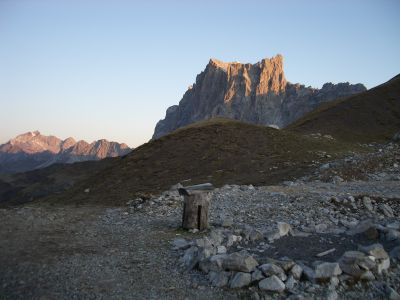
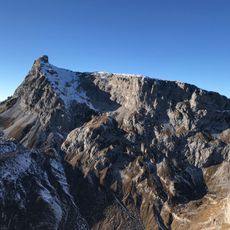
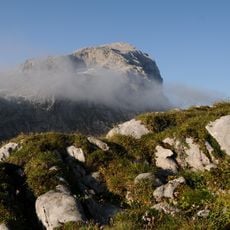
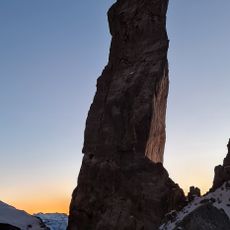
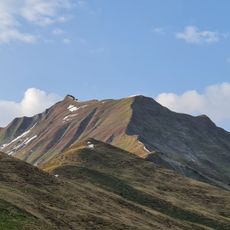
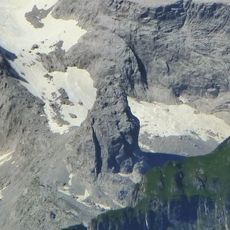
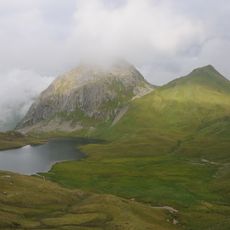
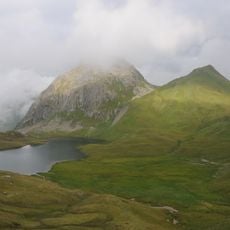
Drusenfluh is a summit in the Rätikon range rising to 2827 meters and forms the natural border between Vorarlberg in Austria and Graubünden in Switzerland. The southern side shows steep rock faces, while the landscape on both sides displays different geographic features.
Christian Zudrell made the first ascent on 14 August 1870, via the Öfatal and the Zudrellband, and chiselled his initials "C Z 70" into the summit rock. Karl Blodig and Eugen Sohm repeated the climb in 1888 through the Blodigrinne and found the stone, ending doubts about Zudrell's claim. In 1995 the weathered stone was brought down and placed at the Lindauer Hütte.
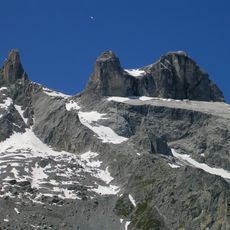
The name Drusenfluh comes from the Alp Drusa on the Schiers side, where "Drusen" is the local word for alpine alders that creep along the slope under snow pressure. The neighbouring three peaks are called Drei Türme, separated from the Drusenfluh by the 2637 m Eisjöchl. The peak stone with Christian Zudrell's initials, C Z 70, is kept at the Lindauer Hütte.
The mountain is accessible via several routes on the southern side in Swiss territory, and visitors should prepare for changing weather conditions. Equipment should be appropriate for alpine conditions, as the elevation and terrain require special precautions.
The Drusenfluh (2827 m) and the Drei Türme are separated by the Eisjöchl, a saddle at 2637 m. The highest of the three towers reaches 2830 m and stands north of the main ridge on Austrian soil, so the massif's top is not the border summit.
The community of curious travelers
AroundUs brings together thousands of curated places, local tips, and hidden gems, enriched daily by 94,419 contributors worldwide.