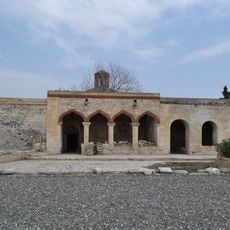
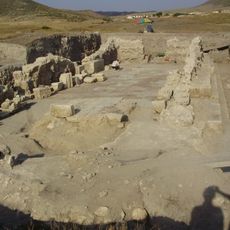
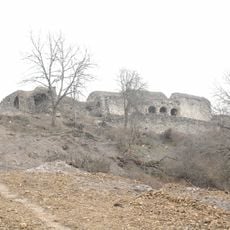
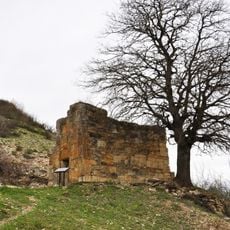
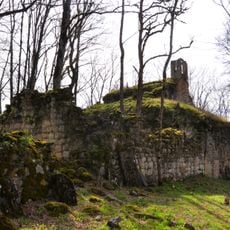
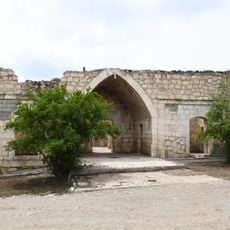
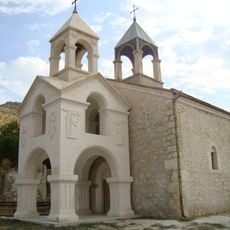
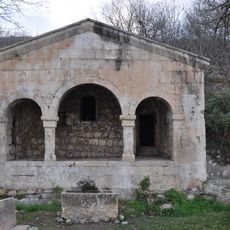
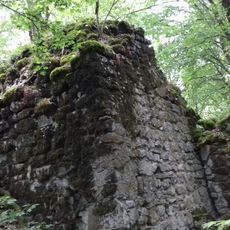
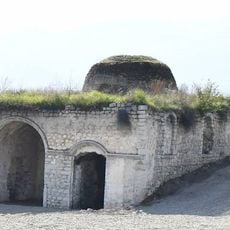
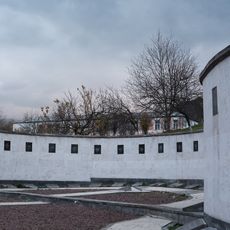
Khachin-Turbatli Mausoleum, 14th-century mausoleum in Xaçındərbətli, Azerbaijan.
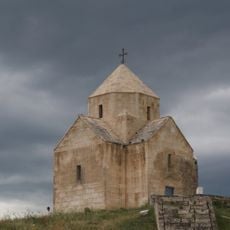
The Khachin-Turbatli Mausoleum is a 12-sided stone structure built from pale yellow limestone with a pyramidal roof that rises above the surrounding landscape. The building displays the characteristic geometric precision and crafted detailing of the Arran architectural tradition.
The mausoleum was completed on Monday, 15 July 1314, as the tomb of Qutlu Khwaja, son of Musa, a powerful figure in the Khachin province. An Arabic inscription over the upper chamber names the builder as ustad Shahbenzi. From summer 1993 to 2020 the area was controlled by the unrecognized Nagorno-Karabakh Republic.
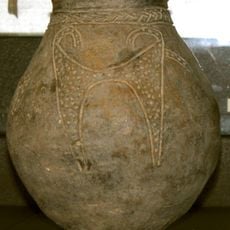
The village name Xaçındərbətli derives from the tomb: Xaçın plus türbə(t) plus li, after the mausoleum became a pilgrimage site. The Arabic inscription over the upper chamber names the deceased Qutlu Khwaja, son of Musa, the date 15 July 1314, and the master Shahbenzi. Carved on the facades are animals painted dark red: an ox, lion, deer, hare, and a predator tearing a deer.
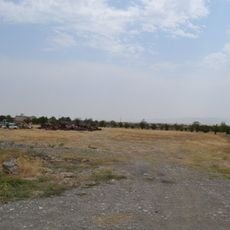
The mausoleum sits on open terrain north of Aghdam, accessible by road from the city. A visit works best during fair weather to fully appreciate both the structure and the landscape surrounding it.
The Arabic inscription over the upper chamber's doorway gives the deceased as Katava Hoja, son of Musa, the date Monday 15 July 1314, and the craftsman ustad Shahenzi. On the facades, animals such as a predator tearing a deer, a winged griffon, deer and roe deer are engraved and painted dark red, motifs compared to Armenian carvings at Geghard and Saghmosavank.
The community of curious travelers
AroundUs brings together thousands of curated places, local tips, and hidden gems, enriched daily by 94,522 contributors worldwide.