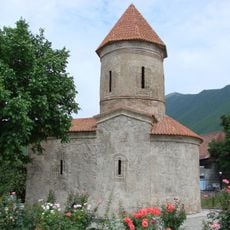
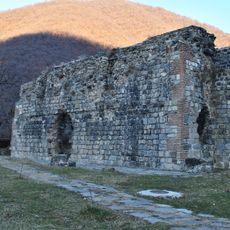
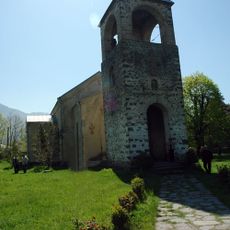
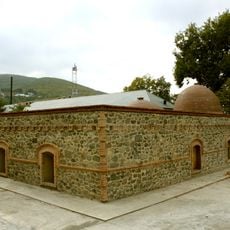
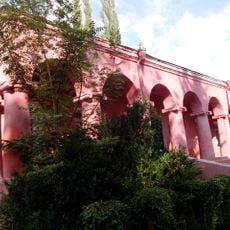
Ulu mosque, İlisu, Friday mosque in İlisu, Gakh District, Azerbaijan.
Ulu mosque stands on the main square of İlisu, in Azerbaijan's Qakh district. Its plan is a strongly elongated rectangle of 13 by 26 m on a north–south axis, made of two squares divided by stone cruciform supports and pointed arches into nine cells. Three northern cells form the portico-eyvan; the north facade has three pointed openings in a projecting rectangular frame.
Built in 1700, the mosque is one of seven of the nine that once stood in İlisu to survive to the present. In 1928, during the Soviet campaign against religion, it was among the mosques transferred to clubs for educational use. On 2 August 2001, Cabinet of Ministers decision No. 132 listed it as an immovable historical and cultural monument of national importance.
Locals call it Ulu məscid, the "great mosque", because it is the largest and oldest of the nine mosques that once stood in İlisu; seven survive. Its name in Tsakhur, Ülcuman meçet, and in Azerbaijani, Cümə məscidi, marks it as the Friday congregational mosque of the village.
The mosque stands on İlisu's main square, its long axis running north-south, so the three-arched northern facade is the one you meet first from the village centre. The prayer hall is entered through the portico-eivan formed by the three northern cells. Modest dress is expected in the working mosque.
Of the nine mosques that once stood in İlisu, seven survive; the Ulu mosque is the largest and oldest, which is why locals gave it the name Ulu, meaning "great". The building is dated to 1700 and was listed as a monument of national importance by Cabinet of Ministers decision No. 132 of 2 August 2001.
The community of curious travelers
AroundUs brings together thousands of curated places, local tips, and hidden gems, enriched daily by 93,365 contributors worldwide.