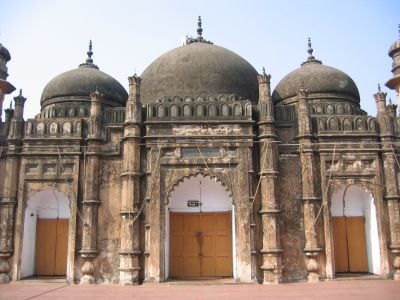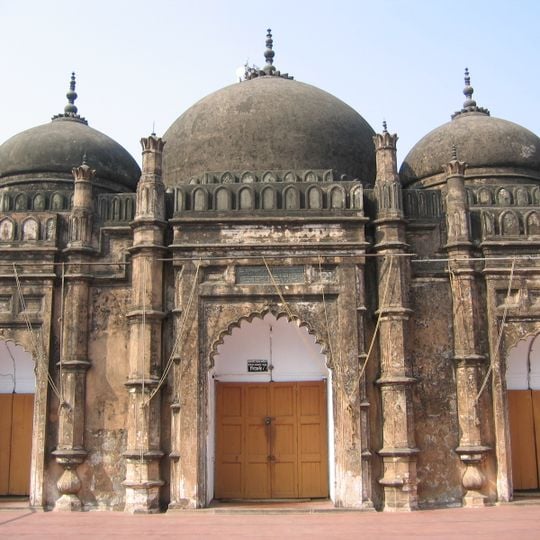
Khan Mohammad Mridha Mosque, Mughal mosque in Old Dhaka, Bangladesh.
Khan Mohammad Mridha Mosque is a Mughal-era mosque in Old Dhaka, Bangladesh, built on a raised platform with three rounded domes crowning a rectangular prayer hall. Slender towers mark each corner of the structure, and an exterior stairway on the eastern side leads up to the entrance.
Khan Mohammad Mridha built the mosque in Atish Khan Mahalla in 1706 CE on the instruction of Qadi Ibadullah, the chief qazi of Dhaka, who ordered the construction in 1704–05 during the rule of Deputy Governor Farrukhsiyar. A madrasa was added north-west of the mosque, where its founding teacher Mawlana Asadullah (d. 1709) taught fiqh, philosophy and logic in Arabic and Persian, funded by the Nawabs of Bengal. In 1913 the Archaeological Survey of India listed the building, then known as Mirza's Masjid, as a historic monument.
The mosque is named after Khan Mohammad Mridha, who built it in 1706 on the order of Qadi Ibadullah, Dhaka's chief qazi. A madrasa once stood north-west of the mosque, where its founding teacher Mawlana Asadullah taught fiqh, philosophy and logic in Arabic and Persian until his death in 1709, funded by the Nawabs of Bengal. The arcaded hujra in the northern annex still shelters travellers and visitors.
The site is reached by climbing the exterior stairway on the eastern side, which leads directly to the elevated prayer hall. As this is an active place of worship, visitors should dress modestly and avoid peak prayer times.
The raised platform is hollow underneath, with vaulted chambers running along three sides that once served as living quarters. Most visitors walk straight up the stairs without realizing this lower level exists at all.
The community of curious travelers
AroundUs brings together thousands of curated places, local tips, and hidden gems, enriched daily by 94,049 contributors worldwide.