St Hubert's Key, Religious object in the Ardennes, Belgium
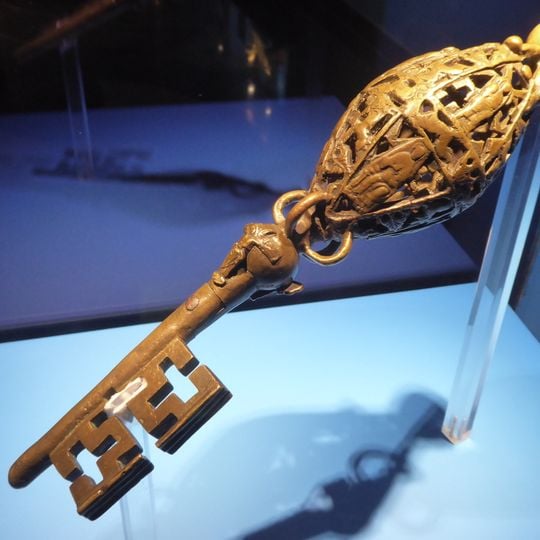
St. Hubert's Key is a metal object shaped like a nail, cross or cone, and the example shown is a gilded key with a rectangular bit and a hollow egg-shaped cage of interlocking strips, joined by a ring and a small sculpted animal head. It was heated and pressed onto dog bites as a rabies cure.
The key's origin is placed in Liège around the mid-12th century, possibly linked to efforts to restore the reputation of the Church of Liège after the Investiture Controversy. Written sources only mention it from the mid-13th century, after transformations during renovation of the collegiate church of Saint-Pierre de Liège, Saint Hubert's original burial place. Its use was banned by the Church in 1828.
The key takes its name from St Hubert, patron saint of hunters, mathematicians, opticians and metalworkers. At the monastery of St Hubert in the Belgian Ardennes it was consecrated to him and used to protect dogs and other domestic animals from rabies; healed pilgrims made their way to Nonnweiler. The object shown is a gilded key with a sculpted animal head and an openwork cage.
The key is a sacramental object kept at the collegiate church of Saint-Pierre in Liège, Saint Hubert's original burial place, where sources first mention it in the mid-13th century. It is not a museum piece in a cathedral treasury; look for it in the context of the Liège church's relics. The object shown is a dull gold-coloured key with an openwork egg-shaped cage and a small animal head at the shaft.
The key's association with Saint Peter and Saint Hubert served to link the founder of the universal Church with the founder of the local Church of Liège, whose reputation had been weakened by the Investiture Controversy. The relic is thought to have appeared in Liège around the middle of the 12th century, though written sources only mention it from the mid-13th century, after transformations during renovation of the collegiate church of Saint-Pierre de Liège, Saint Hubert's original burial place.
The community of curious travelers
AroundUs brings together thousands of curated places, local tips, and hidden gems, enriched daily by 93,622 contributors worldwide.