Bratska mogila, Memorial complex in Plovdiv, Bulgaria
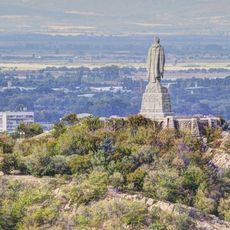
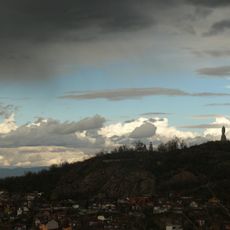
Bratska mogila is a memorial complex in the eastern part of Plovdiv's Park of Recreation and Culture, in the Smirnenski quarter. It symbolizes a Thracian burial mound and, seen from above, resembles a stylized stone wreath. Its 90-metre-long sculptural composition is made of concrete, limestone and bronze, and an eternal flame once burned at its centre.
The first competition for the memorial was held in 1955 and won by architects Lyubomir Shinkov and Matey Mateev with a design for Nebet Tepe, but it was never built. After further failed competitions, a collective led by Shinkov, with architect Vladimir Rangelov and sculptors Lyubomir Dalchev, Ana Dalcheva and Petar Atanasov, was chosen in 1968. Todor Zhivkov inaugurated the monument on 9 September 1974, the 30th anniversary of the 1944 coup.
The memorial's 90-metre sculptural composition depicts the struggle for liberation from Ottoman rule, the Unification of Bulgaria, the September Uprising and the partisan movement. In the centre an eternal flame once burned. The remains of 126 partisans rest in bronze urns set in three cubes, arranged in seven rows of six.
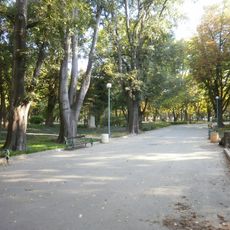
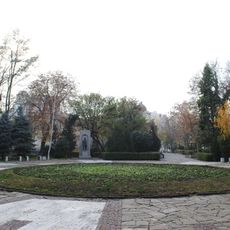
The memorial stands at the end of a commemorative path in the Park of Recreation and Culture, which means you reach it on foot. Access is usually restricted to special events, so checking current conditions before visiting is worthwhile.
The memorial holds the remains of 126 communist partisans from World War II, placed in bronze urns set into three large cubes arranged in seven rows of six. The crypt also keeps the remains of Lilyana Dimitrova and Yordanka Chankova.
The community of curious travelers
AroundUs brings together thousands of curated places, local tips, and hidden gems, enriched daily by 93,497 contributors worldwide.