Monte Carupina, Mountain summit in Oiapoque, Brazil
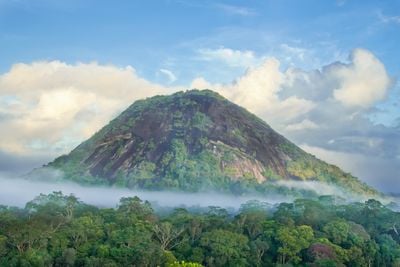
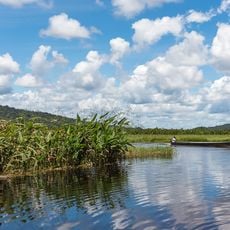
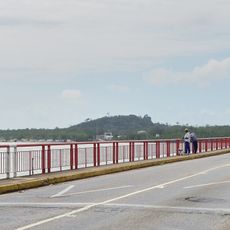
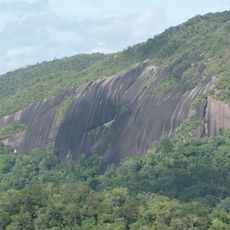
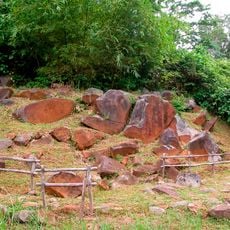
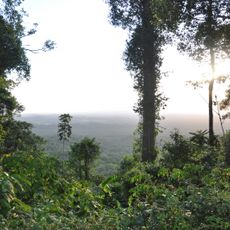
Monte Carupina is a mountain summit in the northern Amazon region that rises about 300 meters above its surroundings. The landscape features gentle rounded slopes within dense rainforest, forming a prominent elevation across the terrain.
Monte Carupina appears in European travel accounts as early as the 17th century: the Dutch geographer Johannes de Laet described it in 1631 and 1644 as rising "in the form of a natural pyramid", with a fine view over the land and coast. The hill consists of granite cut by broad quartz veins, set in the Precambrian Guiana Shield.
The mountain lies in the Terra Indígena Uaçá, territory long inhabited by the Palikur and other indigenous peoples. In the 17th century these peoples saw Monte Carupina as a seat of demons and spirits, and as the refuge where people and animals survived a flood sent by the god Ohogri, whose boat of fired clay ran aground on the mountain. Palikur tradition also holds that the region's hills, Carupina among them, swam across the ocean and only solidified after the flood.
Monte Carupina lies inside Terra Indígena Uaçá, an indigenous protected area, so access should be arranged with the responsible indigenous authorities before any visit. The nearest town is Oiapoque, in Amapá state; the hill rises from flat fluvial and fluviomarine sediments, surrounded by rainforest. The summit is low, about 300 m according to German sources, and the surrounding terrain is largely flat.
The mountain is one of four prominent hills rising from flat fluvial and fluviomarine sediments. In Palikur mythology the hills of the region swam across the ocean to land, and Carupina only solidified after the flood. Johannes de Laet described it in 1631 and 1644 as rising "in the form of a natural pyramid".
The community of curious travelers
AroundUs brings together thousands of curated places, local tips, and hidden gems, enriched daily by 93,847 contributors worldwide.