Parque Arqueológico do Solstício, Archaeological park in Calçoene, Brazil.
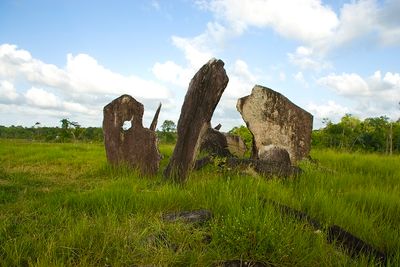
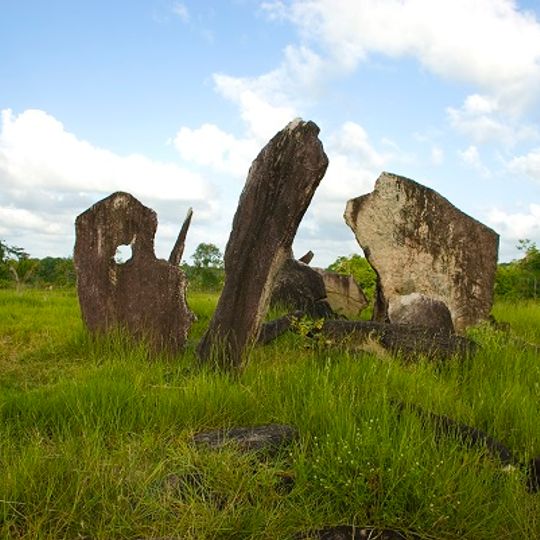
The Solstice Archaeological Park, known academically as AP-CA-18, is a circle of 127 upright granite blocks, each up to 4 metres tall, set on a hilltop on the bank of the Rego Grande River in Amapá. The ring measures over 30 metres across. The stones are rough and irregular, mottled with pale lichen; one broad slab has a circular hole through its upper part, and the tallest block leans to one side.
Naturalist Emilio Goeldi reported the Rego Grande stones in the late 19th century, and locals long called the site Tropical Stonehenge. Excavation only began in 2005, after a geologist noted the circle during a socioeconomic study. Carbon dating of pottery sherds places the occupation between 500 and 2,000 years ago; two pits about 1.5 to 2 metres deep, covered by stone slabs, held intact urns and cremated human remains.
The stone arrangement shows deep knowledge about the sky that was made visible by people who lived here long before us. Today, visitors can see how the stones align to mark moments in the yearly cycle.
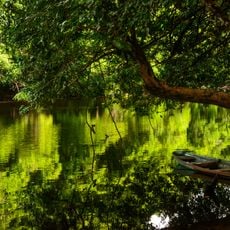
The site lies on a hilltop by the Rego Grande river, reached from Calçoene via the AP-260 highway; the final stretch is unpaved. Access is difficult due to the remote location and lack of infrastructure, and the area is an environmental preservation zone. Excavations have been underway since 2006, so some sectors may be closed off.
On the December 21 solstice, sunlight passes through a circular hole carved in one block and falls on another stone for an extended period. Two pits about 1.5 to 2 metres deep, covered with stone slabs, held three intact urns in a triangular arrangement, along with cremated human remains and pottery shaped like animals and human figures.
The community of curious travelers
AroundUs brings together thousands of curated places, local tips, and hidden gems, enriched daily by 92,838 contributors worldwide.