Grossmünster, Romanesque church in the Old Town, Zurich, Switzerland
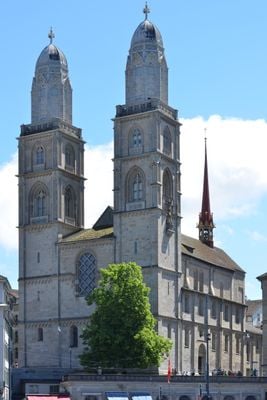
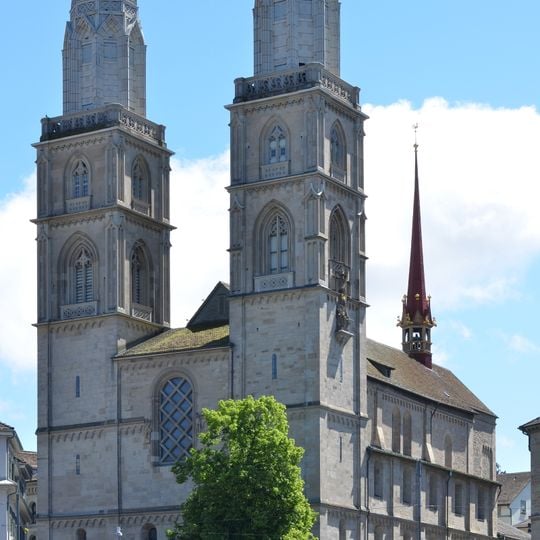
Grossmünster is a Romanesque church of light grey Bollinger sandstone near the Limmat in Zurich's Old Town, built from about 1100 and consecrated around 1220. Two square towers rise in stages on the left of the facade, joined by a lower section with a large circular tracery window; their neo-Gothic tops date from 1787, replacing wooden steeples lost to fire in 1763.
Construction began around 1100 on the site of an earlier Carolingian church and reached completion with consecration around 1220. It became a Protestant church during the Reformation and remains an important spiritual center in the city today.
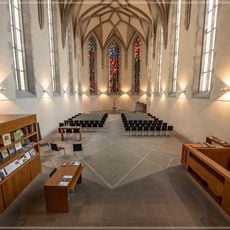
The name Grossmünster appears in records from 1322, likely to distinguish it from the smaller Fraumünster; earlier documents called it simply the "Zürich church". The cloister, dating from the late 12th century, now holds a Reformation museum, and its garden was redesigned in 2009 with ornamental plants chosen in reference to the naturalist Conrad Gessner, who is buried there.
The church stands near the Limmat in Zurich's Old Town, with the Reformation museum housed in the cloister and the theological faculty of the University of Zurich in the adjoining Carolinum building. The twin towers, first erected between 1487 and 1492, can be climbed for a view over the Old Town and the river.
A pillar capital inside the church shows Charlemagne's horse kneeling before Felix and Regula, the scene behind the founding legend. The relics of Charlemagne himself were kept in the Zwölfbotenkapelle and reached Zurich in 1233, after the church was finished.
The community of curious travelers
AroundUs brings together thousands of curated places, local tips, and hidden gems, enriched daily by 93,737 contributors worldwide.