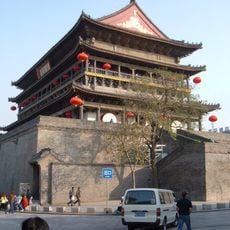
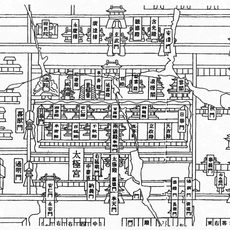
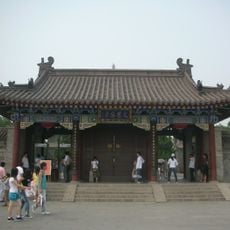
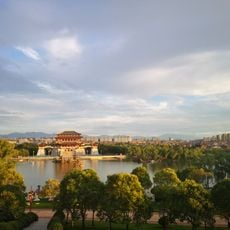
Daxuexixiang Mosque, Religious complex in Muslim Quarter, Xi'an, China.
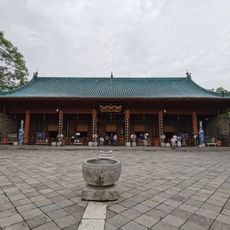
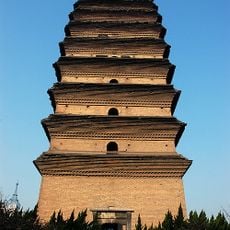
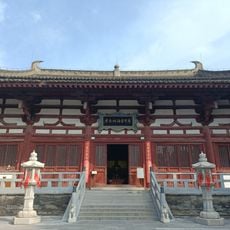
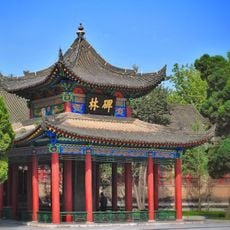
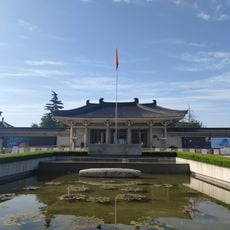
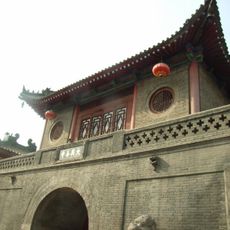
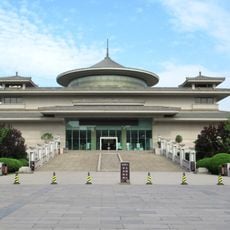
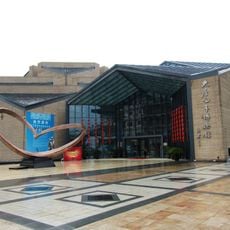
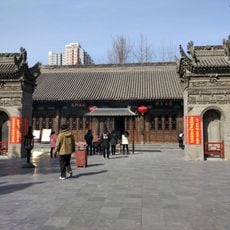
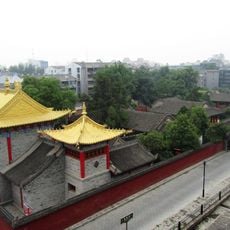
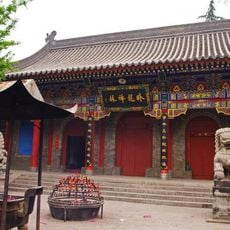
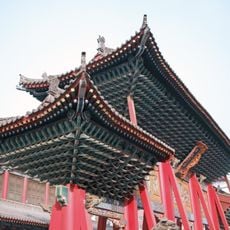
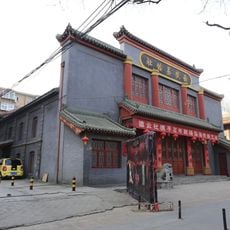
The Daxuexixiang Mosque is a religious complex in the Muslim Quarter of Xi'an comprised of five sequential courtyards containing about twenty buildings. The architecture combines Chinese building traditions with Islamic worship needs through wooden pillars, tiled roofs, and traditional courtyard arrangements.
A stele kept in the mosque records its foundation in 705, during the Tang dynasty. It was first named Qingjiao Si, renamed Tangming Si under Emperor Xuanzong, given the name Huisi Wanshan Si in the Zhongtong era of the Yuan, and received the name Qingzhen Si under the Ming Hongwu emperor. The Hui community built the present mosque in the Ming period, and it was listed as a Major Historical and Cultural Site Protected at the National Level in 2013.
The mosque is also called Xidasi, "West Great Temple", because it faces the Huajuexiang Mosque, the "East Great Temple", across the Hui quarter. A stele bearing Quranic verses and the names of those who wrote them is dated to 740 of the Islamic calendar, 1339–1340, among the oldest evidence of the Chinese Arabic script Xiao'erjing. Ma Zongsheng (1639–1719), founder of the Bijiachang Menhuan branch of the Khufiyya Sufi order, studied and taught here.
Visitors can explore the courtyards and outer areas through multiple gateways, but cannot enter the main prayer hall during prayer times. Arriving early in the day helps you see the spaces peacefully and avoid disturbing daily worship.
A stele kept at the mosque bears Quranic verses and the names of those who wrote them in Xiao'erjing, the Chinese Arabic script; it is dated to the year 740 of the Islamic calendar, that is, between July 1339 and June 1340. It is among the oldest surviving evidence of this script.
The community of curious travelers
AroundUs brings together thousands of curated places, local tips, and hidden gems, enriched daily by 94,467 contributors worldwide.