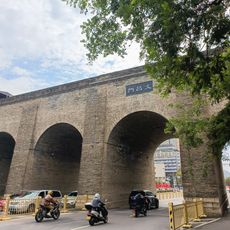
Great Mosque of Xi'an, Mosque in Xi'an, China
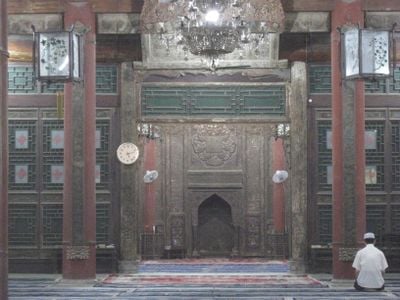
The Great Mosque of Xi'an is a walled mosque complex in Xi'an, China, with five courtyards on an east-west axis and more than twenty buildings across 1.23 hectares. Its wooden prayer wall has a central arched doorway, a dark pointed arch recess framed by carved floral panels, three green rectangular panels above, and a carved frieze supporting a chandelier. Two reddish-brown pillars flank it, one bearing a round white clock.
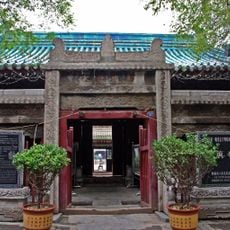
Emperor Xuanzong decreed around 742, during the Tang dynasty, that a place of worship be built for Chang'an's Muslim community, then known as Tangmingsi. Most of that original structure was lost with the Tang and Song collapses, and the mosque was rebuilt at least four times, including by the Yuan government around the 1260s as Huihui Wanshansi. The present form was built in 1392 under Emperor Hongwu of the Ming, as recorded in the Records of Xi'an Municipality, with a front gate, paifang and sebil added under the Qing.
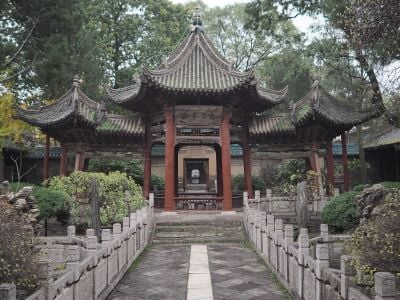
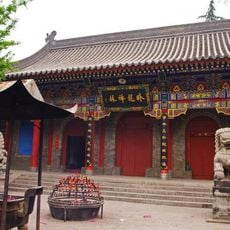
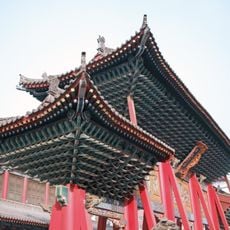
The mosque follows the layout of a traditional Chinese temple with its courtyards and pavilions, yet the prayer direction points toward Mecca. Arabic script decorates the walls beside Chinese dragon motifs, and the prayer hall displays woodcarvings that unite both worlds.
The prayer hall in the fourth courtyard is visible only from outside for visitors, as it remains in active use. The tower in the third courtyard serves as the call to prayer and offers a view over the compound when accessible.
The mosque follows the Gedimu tradition of Sunni Islam under Hanafi jurisprudence, the majority school among China's Hui. Its main prayer hall holds 1,000 people, yet about 100 worshippers attend a typical Friday service. The octagonal three-storey Xingxin Tower in the third courtyard may have served as the minaret, as suggested by art historian Nancy Steinhardt.
The community of curious travelers
AroundUs brings together thousands of curated places, local tips, and hidden gems, enriched daily by 92,857 contributors worldwide.