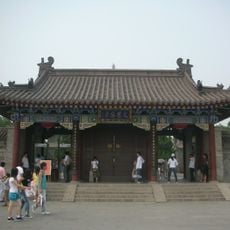
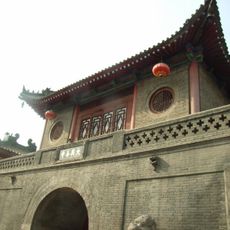
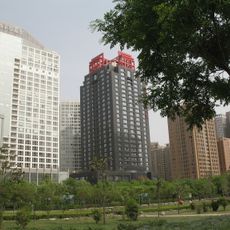
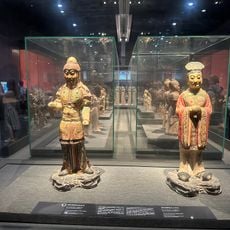
Shaanxi History Museum, History museum in Xi'an, China.
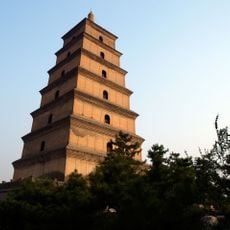
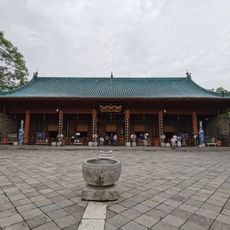
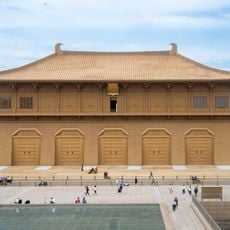
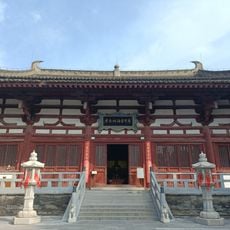
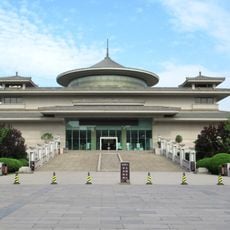
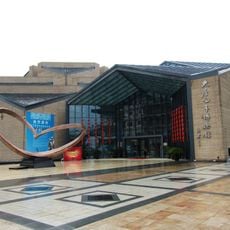
The Shaanxi History Museum stands northwest of the Giant Wild Goose Pagoda in Xi'an, on a 65,000-square-metre site with 55,600 square metres of building. Architect Zhang Jinqiu's Tang-dynasty design places a central hall with storied corner towers on a central axis, and the exhibition halls hold 1,725,754 objects or sets (2021).
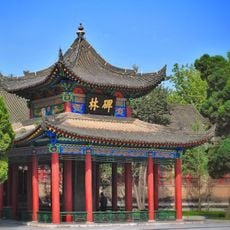
The museum traces its origin to the Shaanxi Provincial Museum founded in 1944 on the site of the Xi'an Beilin. In 1973 Zhou Enlai, visiting the cramped Beilin halls, called for a new museum near the Giant Wild Goose Pagoda. Planning began in 1977, the foundation stone was laid on 28 November 1986, and the building designed by Zhang Jinqiu opened on 20 June 1991.
The museum's name was shortened from "Shaanxi Provincial Museum" in 1986, when the State Planning Commission designated it a national-level museum. Its permanent exhibition, "Shaanxi Ancient Civilization", traces the province from Lantian Man to the eve of the Opium War, and has won the national top-ten exhibition award. The Tang murals and Hejia Village treasures form separate thematic displays.
The museum stands at 91 East Xiaozhai Road, northwest of the Giant Wild Goose Pagoda. Metro lines 2 and 3 stop at Xiaozhai and lines 3 and 4 at Dayanta. Tickets are free but must be reserved online five days ahead, released daily at 17:00; entry stops one hour before closing.
The Empress's Seal, a jade seal from the Western Han dynasty, was excavated near the tomb of Emperor Gao Zu, the first Han emperor, and is counted among the most important imperial seals found in China. The museum also holds the 120 cm Kneeling Archer, unearthed in 1977 from Emperor Qin Shi Huang's tomb.
The community of curious travelers
AroundUs brings together thousands of curated places, local tips, and hidden gems, enriched daily by 92,808 contributors worldwide.