Jinggang Mountains, Nature reserve and tentative World Heritage Site in Jiangxi, China
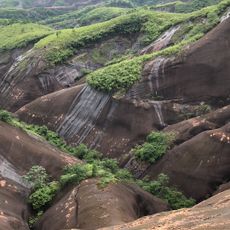
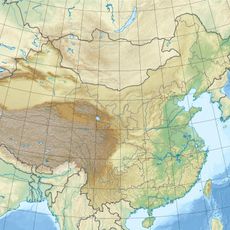
The Jinggang Mountains are a range of the Luoxiao system on the Jiangxi-Hunan border, covering about 670 km2 as thickly forested parallel ridges. The highest point reaches 2,120 m, while the average elevation is 381.5 m. A curved concrete dam with vertical spillways holds a dark reservoir in a narrow valley below bare earth at the water's edge.
After the failed Autumn Harvest Uprising in 1927, Mao Zedong led about 1,000 men to these mountains and set up his first peasant soviet, basing his headquarters at Maoping. In April 1928 Zhu De arrived with his remaining troops and the two proclaimed the Fourth Army. The base expanded to parts of seven counties before the Fourth Army moved to Ruijin in January 1929.
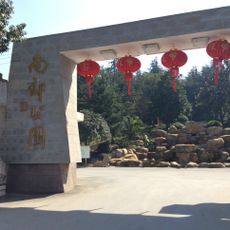
The name Jinggang means "Well Ridge Mountains", from five villages around Ciping whose names mean Big Well, Little Well, Middle Well, Lower Well and Upper Well. The range is celebrated in songs, posters and operas of the early Communist Revolution, and during the Cultural Revolution young Red Guards travelled here on foot to relive the experiences of their revolutionary forebears.
The settlement of Ciping serves as a starting point for exploring hiking trails, monuments, and natural areas around the mountains. Visitors should be prepared for walking and adjusting to varying elevations.
The name Jinggang means "Well Ridge Mountains", after five villages around Ciping whose names mean Big Well, Little Well, Middle Well, Lower Well and Upper Well. The range also holds reserves of porcelain clay and rare earth ore. Farming was nearly impossible on the heights, and a popular story tells of Zhu De carrying grain up the mountain for his troops.
The community of curious travelers
AroundUs brings together thousands of curated places, local tips, and hidden gems, enriched daily by 93,359 contributors worldwide.