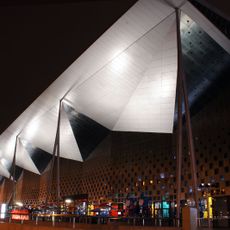
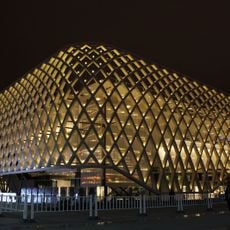
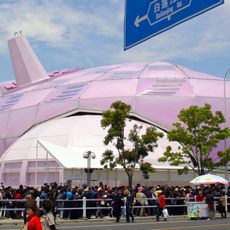
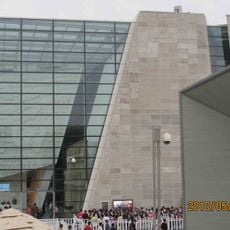
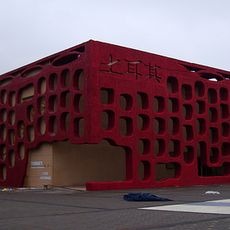
China Pavilion, Expo pavilion in Pudong, Shanghai, China.
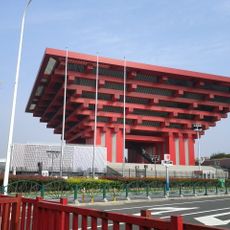
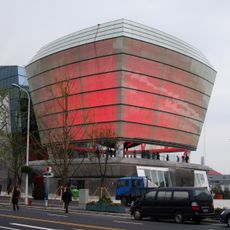
The China Pavilion, known as the Oriental Crown, is a 63-metre inverted pyramid whose four giant columns resemble the legs of a bronze ding vessel and whose body echoes the dougong roof bracket. Its exterior is painted in seven shades of Chinese red, with the characters for north, south, east and west carved on the overhanging columns. The national pavilion covers 27,000 square metres, the adjoining provincial pavilion 45,000.
The design was chosen in 2007 from 344 proposals submitted by Chinese architects, with He Jingtang of South China University of Technology as chief architect. Construction ran from 18 December 2007 to November 2009, and on 8 February 2010 nearly 1,000 designers and workers marked its completion. After Expo 2010 closed, the building was kept and reopened on 1 October 2012 as the China Art Museum.
The structure embodies traditional Chinese architectural elements through its crown-like design and seven shades of Chinese red, symbolizing cultural prosperity and incorporating Confucian philosophy in its exhibitions.
Now functioning as the China Art Museum since 2012, the building features sustainable design elements including solar energy systems, natural ventilation, and a 27,000-square-meter rooftop garden.
The pavilion's inverted pyramid shape earned it the nickname 'The Oriental Crown' and featured multimedia displays that brought Zhang Zeduan's famous scroll painting to life through 3D animation technology.
The community of curious travelers
AroundUs brings together thousands of curated places, local tips, and hidden gems, enriched daily by 92,840 contributors worldwide.