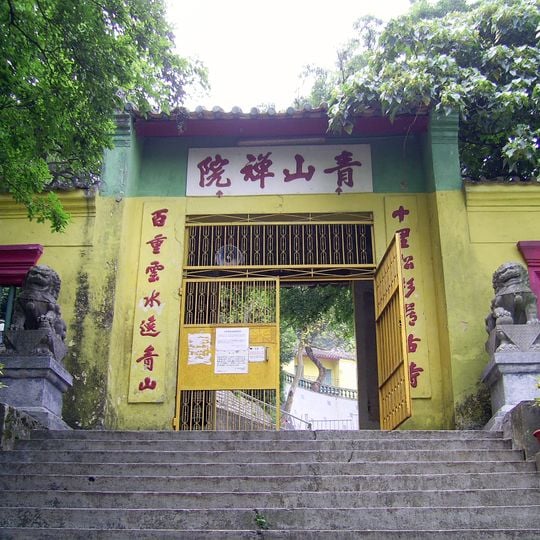
Tsing Shan Monastery, Buddhist temple in Tsing Shan Tsuen, Hong Kong
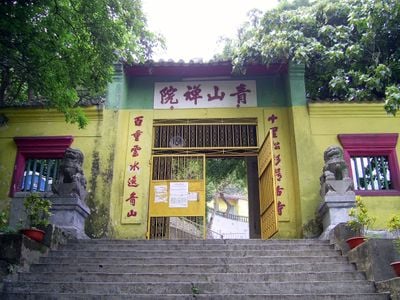
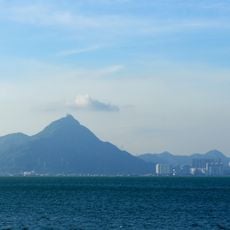
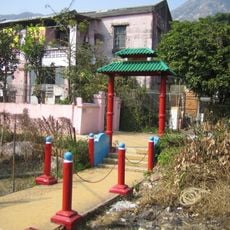
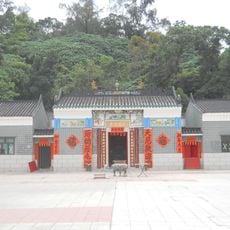
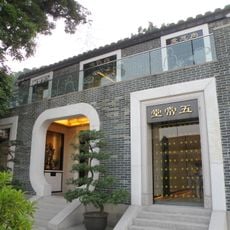
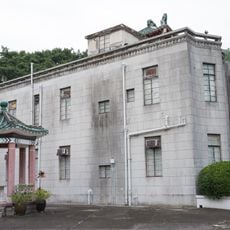
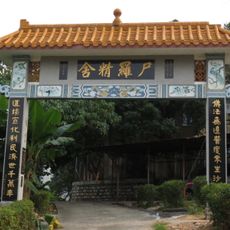
Tsing Shan Monastery is a complex of halls on the eastern slope of Castle Peak, 583 metres high. Its central Main Worship Hall holds statues of Sakyamuni, Amitabha and Bhaisajyaguru, and its roof carries Shiwan ceramic figures of two dragons and carp. The entrance gate bears a plaque reading 青山禪院 and couplets on yellow panels.
The monastery originated around 1,500 years ago during the Eastern Jin period, first established as Pu Du Temple before undergoing several name changes through the centuries. These transformations reflect evolving religious practices and community needs over time.
The monastery shares a triennial ordination cycle with Ling Wan Temple in Pat Heung and Ling To Temple in Yuen Long, known as the "Three Mountains" ordination. This arrangement was established by Abbot Xianqi, Reverend Fahai of Po Lin Monastery and Reverend Miaocan of Ling Wan Temple. The monastery also keeps a fossil bone, displayed in a cage below the Hall of Protectors, which visitors throw coins at for good luck.
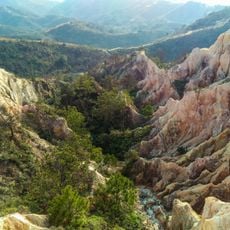
The monastery lies on the eastern slope of 583-metre Castle Peak. A path, Tsing Shan Monastery Path, leads east from Tuen Mun town; from beside the monastery, the Hau Sze Path and Tsing Shan Path climb toward the Han Ling Pin Shek Pavilion near the summit. The site is a group of buildings on stepped ground.
Cup-Crossing Rock, also called Shui Ying Rock, is where the monk Pui To is said to have lived; a stone tablet beside it is carved with the four characters 高山第一, copied in the early Republic from a Song-era inscription attributed to Deng Fu Xie in the style of Han Yu. A three-storey Kalachakra stupa stands next to the rock.
The community of curious travelers
AroundUs brings together thousands of curated places, local tips, and hidden gems, enriched daily by 93,749 contributors worldwide.