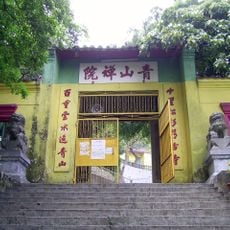
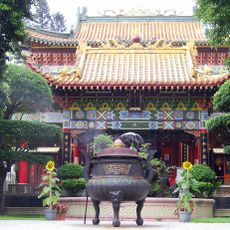
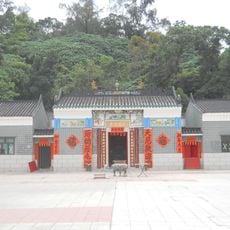
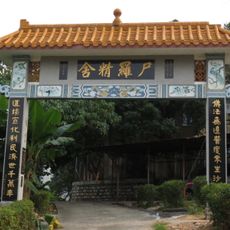
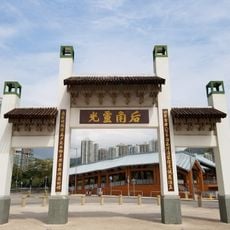
Tsing Wan Kwun, Taoist temple in Tuen Mun District, Hong Kong.
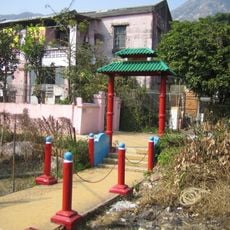
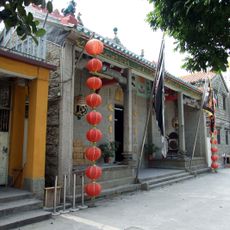
Tsing Wan Kwun is a Taoist temple in Tuen Mun District featuring traditional Chinese architectural elements including curved rooflines, intricate stone carvings, and painted wooden details throughout its buildings. The temple complex contains multiple halls dedicated to different deities, connected by courtyards with planted areas and decorative gates.
Legend traces the site to the Liu Song period, when the monk Beidu is said to have crossed the sea in a wooden cup; a shrine, Beidu An, was built in his memory. It became a Taoist site in 1119, when the Northern Song converted it into the Doumu Palace, and was renamed Tsing Wan Kwun under the Yuan and Ming. The Tuen Mun Tao clan rebuilt and expanded it in the Daoguang era; the 1829 stone lintel survives on the rebuilt temple.
The temple's name, Tsing Wan Kwun (Green Cloud Monastery), was adopted in the Yuan and Ming dynasties after earlier names such as Beidu An and Doumu Palace. Its main deity is Doumu, with Guanyin, the Three Emperors, Lü Zu, Wang Lingguan, Maitreya, Zhu Li Tianjun, Ji Gong, Guan Di and a Thai Buddha also honoured. A long wooden fish and a bell cast in 1842 are kept inside.
The temple is accessible by public transport, with bus routes connecting Tuen Mun to other parts of Hong Kong, and several lines stop nearby. The grounds have steps in places, and visitors should dress respectfully when entering prayer halls and altars.
The temple's stone lintel above the main door is dated to the ninth year of the Daoguang reign (1829), and inside hangs a wooden fish several metres long. A stele from 1843 records fields donated to the temple by the Tuen Mun To clan, and a bronze bell cast in 1842 was given by Tan Xinyi of Nanhai.
The community of curious travelers
AroundUs brings together thousands of curated places, local tips, and hidden gems, enriched daily by 94,048 contributors worldwide.