Elephant Trunk Hill, Natural hill in Xiangshan District, China
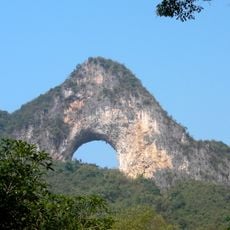
Elephant Trunk Hill is a limestone hill at the confluence of the Taohua and Li rivers in Guilin, Guangxi. Its shape resembles an elephant drinking water, with the trunk reaching into the river. The round opening beneath the trunk is Water-Moon Cave, and a through cave at mid-slope looks like the elephant's eye. Stone steps lead up both sides of the hill.
The sources record no Tang-dynasty origin for the hill. Its documented history is modern: the hill and Water-Moon Cave form the emblem of Guilin, and in 2017 the Two Rivers and Four Lakes–Elephant Hill scenic area was rated a national 5A tourist attraction. The hill also carries the legend of the Jade Emperor's elephant, which turned to stone on the Li River bank.
Local legend says the hill is a heavenly elephant turned to stone: it lingered to drink from the Li River, and the sword the Jade Emperor thrust into its back became the Puxian Pagoda on the summit. The hill is Guilin's city emblem, and Xiangshan Park, built around it, is among the city's best-known parks.
Stone steps climb the hill on both sides, and a through cave at mid-slope resembles the elephant's eye. The Water-Moon Cave, with water flowing through it, sits on the east side beneath the trunk. Xiangshan Park, built around the hill, was rated a national 5A scenic area in 2017 as part of the Two Rivers and Four Lakes–Xiangshan scenic zone.
The arch beneath the trunk is called Water-Moon Cave: at night the moon's reflection passes through the opening, so it seems to float both under and on the water. A local legend says the hill is a heavenly elephant turned to stone, and the handle of the sword that struck it became Puxian Pagoda on the summit.
The community of curious travelers
AroundUs brings together thousands of curated places, local tips, and hidden gems, enriched daily by 93,819 contributors worldwide.