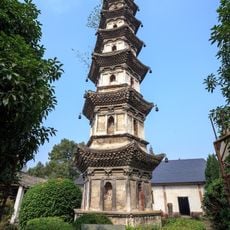
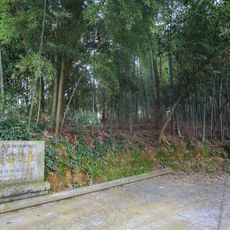
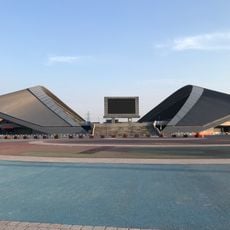
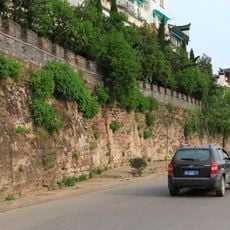
Temple of Southern Confucianism, Confucian temple in Kecheng District, China.
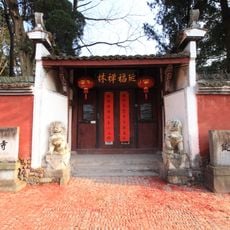
The Temple of Southern Confucianism covers about 13,900 square metres and faces south, with three axes in its southern half and a rear garden to the north. The central axis runs from the gate through Dacheng Gate and a paved path with side halls to the Dacheng Hall, a double-eaved building 16.6 metres wide and 16.5 metres deep. The east axis holds the Kong school, Chongsheng Gate and Chongsheng Shrine; the west axis has the Wuzhi, Xifeng and Liudai Gongjue shrines and the Silu Pavilion.
In 1128 Kong Duanyou, 48th-generation descendant of Confucius, carried wooden statues of Confucius and his wife to Emperor Gaozong's court in Yangzhou. After the capital moved to Lin'an in 1129, the emperor let the Kong family settle in Quzhou, and in 1136 a temple was set up in the prefectural school. A new temple was built in 1253–1254 with 360,000 strings of cash from Emperor Lizong; it burned in 1276, and the present site dates from 1520, rebuilt on its current scale in 1821–1823.
The temple keeps the memory of the 1128 ceremony in Yangzhou, when Kong Duanyou, 48th-generation descendant of Confucius, carried the wooden statues of Confucius and his wife to the rites ordered by Emperor Gaozong. The Quzhou rites for Confucius' birthday were inscribed on Zhejiang's intangible heritage list in May 2005 and on the national list in 2011.
The complex sits on Xinqiao Street in Kecheng District, covers about 13,900 square metres and is laid out on three north-south axes: the temple on the central axis, the Kong family residence west of it, and the rear garden to the north. Enter through the main gate and follow the central axis past the Dacheng Gate and the stone-paved path to the Dacheng Hall. The site is a national protected monument, so walking is on paved courtyards and thresholds rather than rough ground.
The temple holds the wooden statues of Confucius and his wife that Kong Duanyou carried south in 1128, when Emperor Gaozong summoned him to sacrifice at his Yangzhou palace. These statues are the reason the southern branch of the Kong family kept its own ancestral temple in Quzhou.
The community of curious travelers
AroundUs brings together thousands of curated places, local tips, and hidden gems, enriched daily by 93,898 contributors worldwide.