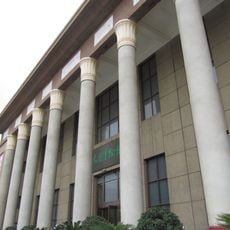
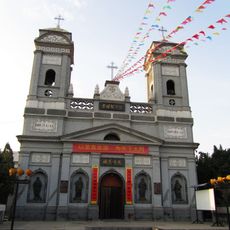
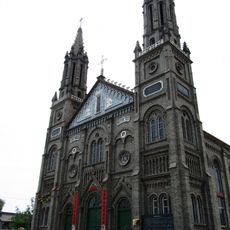
Baoning Temple, Buddhist temple in Shanxi, China
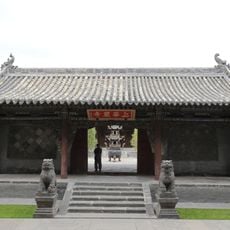
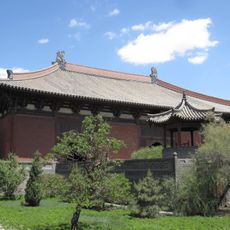
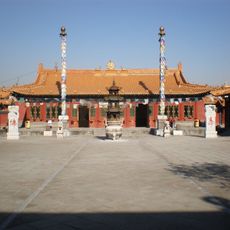
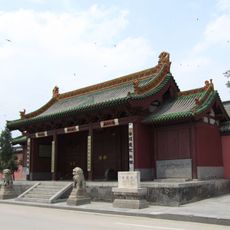
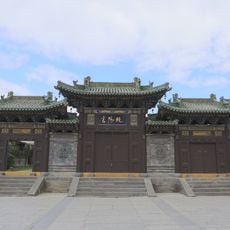
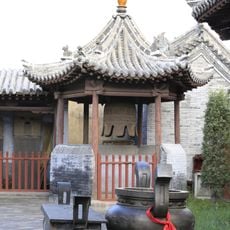
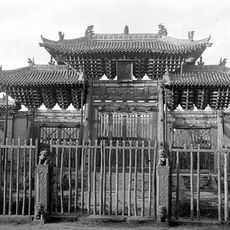
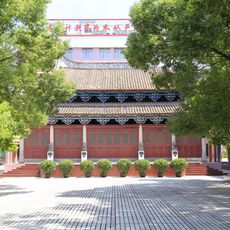
Baoning Temple stands on the north side of East Street in Youwei Town, Youyu County, Shuozhou, Shanxi. Of the original four courtyards and five halls aligned south to north, only two remain: the Tianwang Hall, five bays wide with a suspended roof, and the Mahavira Hall, also called Huayan Hall, seven bays wide (23.50 m) and three deep (13.60 m) under a single-eaved hip-and-gable roof. Its bracket sets are five-step with double descending cantilevers.
Baoning Temple was built in 1460, the fourth year of the Ming Tianshun era, by the Youyu Linwei guard, one of the garrisons set up to defend against Tatar incursions. A 1474 stele records the foundation. It was rebuilt in 1488 and again in 1709, and was badly damaged during the Sino-Japanese War and the Cultural Revolution.
The temple's name is tied to the 136 water-and-land paintings it once housed, produced in the Ming dynasty and kept in the Shanxi Museum since 1955. A 1815 inscription records that they were hung each year for the Buddha's birthday bath festival, when worshippers gathered to burn incense and bow before them.
The temple stands on the north side of East Street in Youwei Town, Youyu County, Shuozhou. Only the Tianwang Hall and the Mahavira Hall survive, so the visit is short; the halls face south along the former central axis. The 136 water-land paintings once kept here are now in the Shanxi Museum in Taiyuan, not on site.
The temple's 139 water-and-land paintings, mostly Ming works on silk, were carried to Suiyuan by Youyu residents during the war against Japan, returned after 1949, and are now held by the Shanxi Museum, where some hang in the "Buddhist Legacy" gallery.
The community of curious travelers
AroundUs brings together thousands of curated places, local tips, and hidden gems, enriched daily by 93,794 contributors worldwide.