Yungang Grottoes, Buddhist temple caves in Datong, China
The Yungang Grottoes are caves carved into sandstone cliffs near Datong in Shanxi province that hold Buddhist sculptures. The site spans multiple sections with hundreds of chambers in different sizes, each containing hand-carved figures and relief carvings from floor to ceiling.
The earliest caves, 16–20, were cut from 460 under the monk Tanyao, who asked Emperor Wencheng to carve five caves at Wuzhou Shan, each symbolising a Northern Wei emperor. Imperial work continued until 494, when the court moved to Luoyang; private patrons then carved the smaller western caves until uprisings halted work in 525.
The site's name comes from Wuzhou Shan, the mountain in whose southern cliff the caves are cut; the Chinese name is Yungang Shiku. Cave 16's south wall carries reliefs of six musicians playing cymbals, waist drum, a reed pipe, conch, panpipes and a barrel drum; five wear braided hair, marking northern minority origins. Cave 19 holds the earliest large narrative scene at Yungang, the 3-metre Rāhula story.
The site is best explored on foot, allowing you to move through the different cave groupings at your own pace. Plan to spend several hours and wear comfortable shoes, as the paths between sections involve climbing and uneven terrain throughout the area.
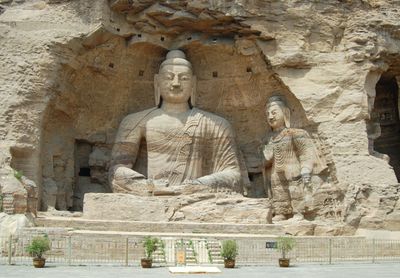
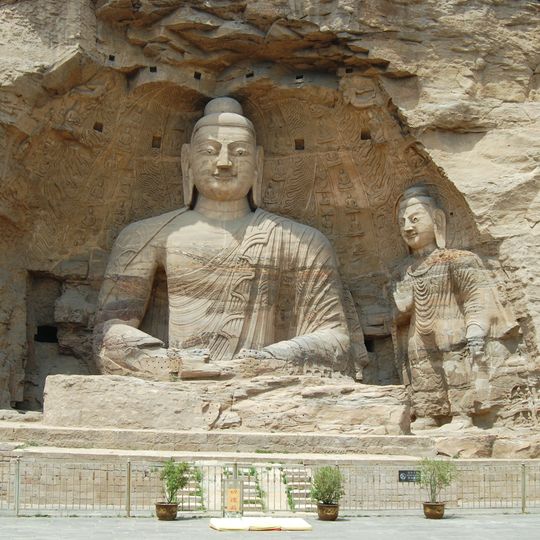
Cave 20's seated Buddha, 13.7 m tall, was originally enclosed; its front wall collapsed, leaving the figure open to the sky. The 512 CE Datong earthquake, estimated at magnitude 8, is blamed for the collapse. Excavations in 1992 found over 130 robe-fragment stones buried in 1.4 m of Northern Wei burnt earth, cut from the lost west standing Buddha for a repair abandoned after the quake.
The community of curious travelers
AroundUs brings together thousands of curated places, local tips, and hidden gems, enriched daily by 92,793 contributors worldwide.