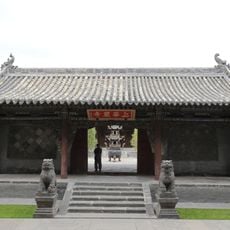
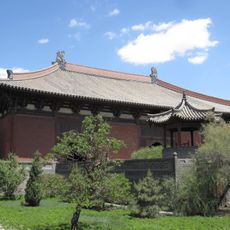
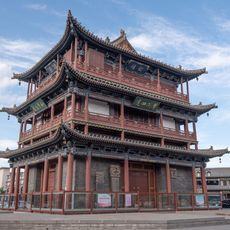
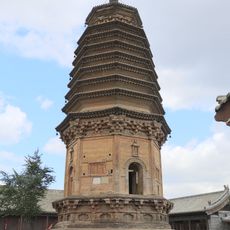
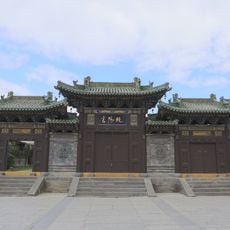
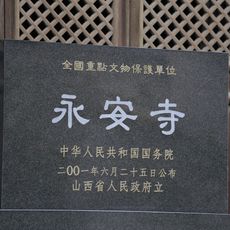
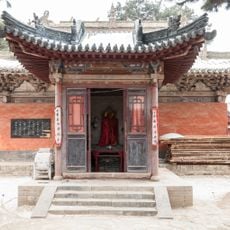
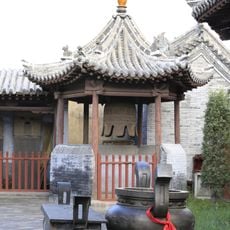
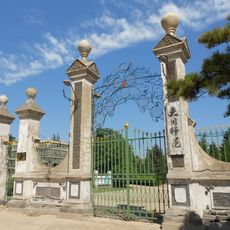
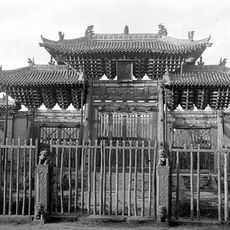
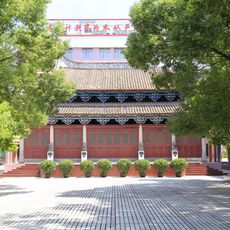
Jingtu temple in Yingxian, Buddhist temple in Ying County, China.
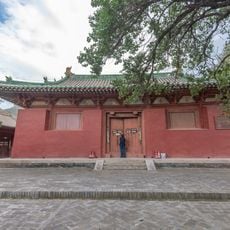
Jingtu Temple, also called Beisi, stands in the northeast corner of Ying County town, Shuozhou, Shanxi. Of the former two-courtyard complex only the Jin-era Mahavira Hall (Daxiong Baodian) remains: a three-bay by three-bay timber hall with reduced and shifted columns, whose ceiling holds nine coffered caissons in three rows of three.
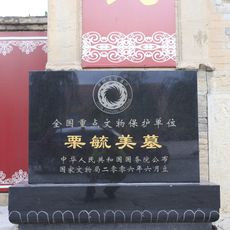
The temple was founded during the Jin Dynasty and underwent changes and restoration through successive periods. In 2006, the site gained status as a nationally protected cultural monument in China.
The name Jingtu, "Pure Land", refers to the Buddhist school whose name the temple bears. The nine coffered ceilings of the main hall carry dragon-and-phoenix, lotus and ruyi motifs in green, red and gold, and the central one encloses a miniature celestial palace with a nine-ridge roof, read as the seven-jewelled pavilion of the Pure Land. The hall's walls keep Qing-dynasty paintings of Buddhas and bodhisattvas.
The temple stands in the northeast corner of Ying County town, in Shuozhou, Shanxi. Only the main hall, the Daxiong Baodian, survives, so the visit is short and focused on its interior ceiling. Look up as soon as you enter: the nine coffered ceilings cover the whole roof frame.
The nine coffered ceilings (zaojing) over the main hall are not load-bearing: their small dougong brackets are purely decorative. The central bay's ceiling, about 4,198 mm across at its base, rises through a square well, an octagonal well and a third tier rotated 45 degrees, with a miniature gate tower and covered galleries around the square well.
The community of curious travelers
AroundUs brings together thousands of curated places, local tips, and hidden gems, enriched daily by 93,091 contributors worldwide.