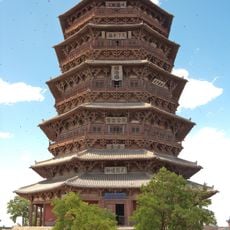
Ayuwang Pagoda, Buddhist chorten in Shanxi, China.
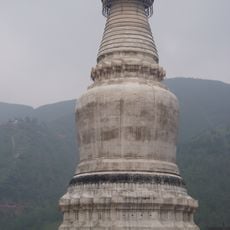
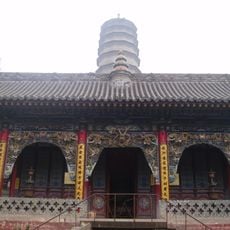
The Ayuwang Pagoda is a Tibetan-style stupa of brick, about 40 metres high, standing on a rectangular platform in the courtyard behind the Dai County government offices. Its circular base is a sumeru pedestal carved in relief with large lotus petals and honeysuckle scrolls; the plain dome carries a stepped finial seat with twelve columns around a small south-facing round door, thirteen rings above, and a copper gourd at the top.
The Ayuwang Pagoda was first built in AD 601 under the Sui dynasty, when Emperor Wen ordered stupas built across the empire; it was a 13-storey wooden tower. Destroyed and rebuilt repeatedly, it burned in 1079 and was rebuilt in 1102, then ruined again in the Mongol conquest of Jin. The present brick-and-stone structure dates to 1275, under Kublai Khan's Yuan dynasty, and was repaired after Qing-era earthquake damage. It was listed as a Major Historical and Cultural Site Protected at the National Level on 25 June 2001.
The name honors Ashoka, the Mauryan emperor who converted to Buddhism around 263 BC and patronized the religion. The tower stands on the grounds of what was Yuan'guo Temple, rebuilt in 847 after the Tang persecution; the temple buildings are gone but the pagoda remains. In 1937 Liang Sicheng and Lin Huiyin surveyed it and praised its proportions in their history of Chinese architecture.
The pagoda stands in the courtyard behind the Dai County People's Government on Dong Dajie in Shangguan Town, Dai County. It is a working government compound, so access to the courtyard may be restricted; ask locally before entering. The circular brick base and the 40-metre height are best seen from the open ground around it.
The present brick-and-stone structure dates from 1275, when it was rebuilt by order of the Yuan, not from the Sui original. The 1907 photograph by French sinologist Édouard Chavannes still shows the halls of the surrounding Yuanguo Temple, which have since disappeared, leaving the pagoda standing alone. In 1937 Liang Sicheng and Lin Huiyin surveyed it and judged it the best-proportioned bottle-shaped pagoda surviving in China.
The community of curious travelers
AroundUs brings together thousands of curated places, local tips, and hidden gems, enriched daily by 93,806 contributors worldwide.