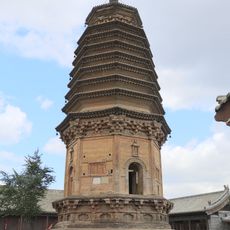
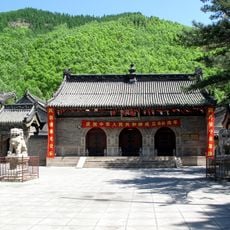
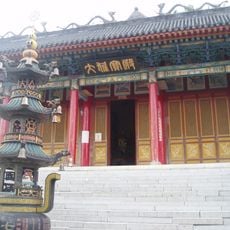
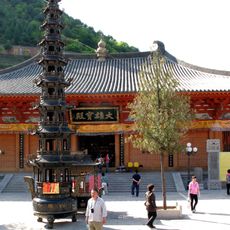
Gongzhu Temple, Buddhist temple in Fanshi County, China.
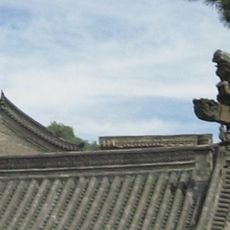
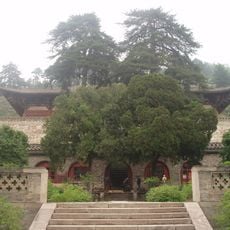
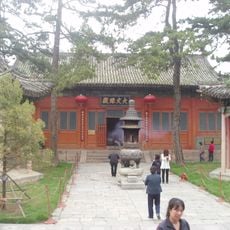
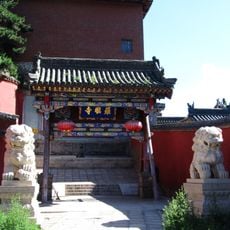
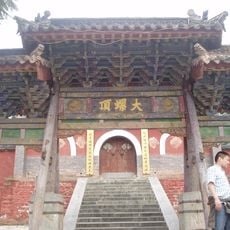
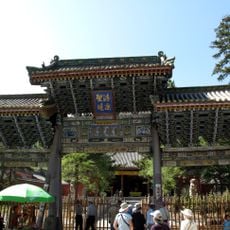
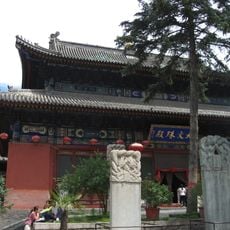
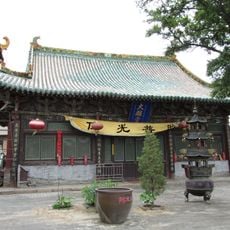
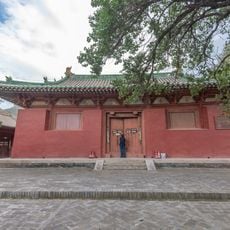
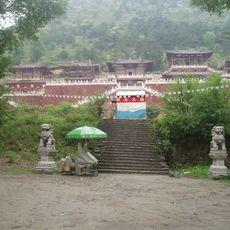
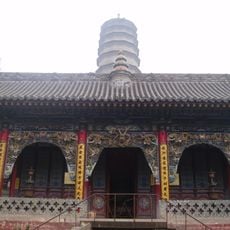
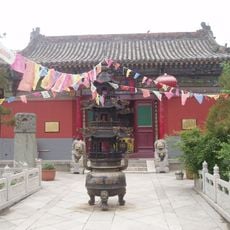
Gongzhu Temple is a Buddhist complex facing south, with a 4,347-square-metre site and 1,116 square metres of buildings. Its three courtyards hold a shanmen, a second hall, a Weituo hall, a Mahavira hall and side halls; the Mahavira hall and second hall are Ming, the rest Qing. The Mahavira hall has a single-eave overhanging gable roof without bracket sets.
Originally constructed during the Northern Wei dynasty between 386 and 534 AD, the temple was established according to legend by Princess Chengxin and later underwent significant renovations during the Ming Dynasty period.
Inside the Mahavira Hall, Sakyamuni sits in the centre with Amitabha and Bhaisajyaguru on either side, and Ananda and Kassapa stand before him. Thirty Ming dynasty statues fill the hall, with the Eighteen Arhats seated along both gable walls. More than 90 square metres of frescoes cover the inner walls.
The complex faces south and is entered through the shanmen gate, followed by the Second Hall, Mahavira Hall and Back Hall along the central axis. The Mahavira Hall keeps its Ming-dynasty timber frame, with a 35-centimetre-high base and a single-eave overhanging gable roof.
The Records of Qingliang Mountain (Qingliang Shan Zhi) states that Gongzhu Temple fell under the jurisdiction of Mount Wutai, not the reverse. The temple was made a provincial key cultural preservation unit on 18 August 1986, and entered the sixth batch of national sites on 25 May 2006.
The community of curious travelers
AroundUs brings together thousands of curated places, local tips, and hidden gems, enriched daily by 93,976 contributors worldwide.