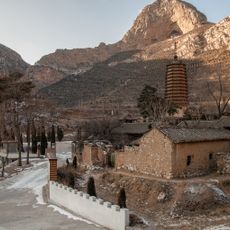
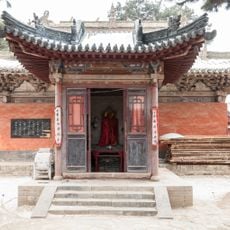
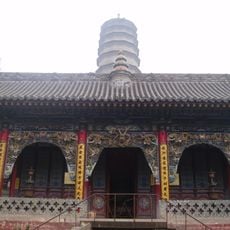
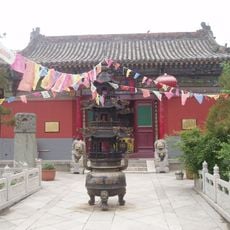
Dailuoding, Buddhist temple in Mount Wutai, China
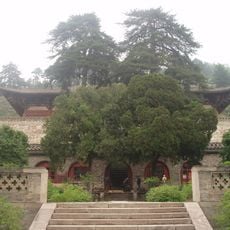
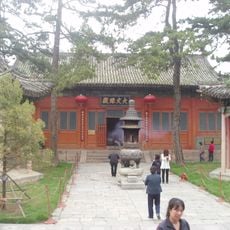
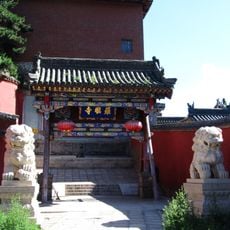
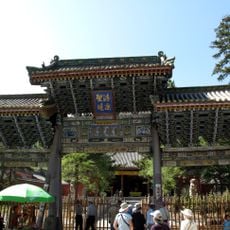
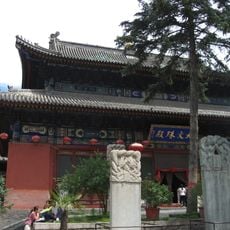
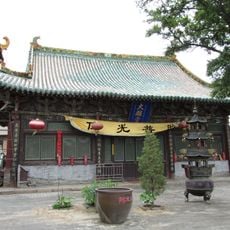
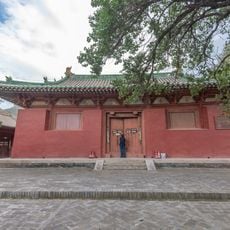
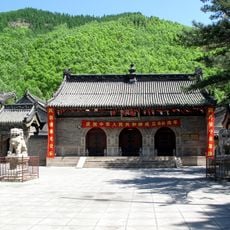
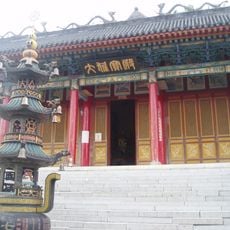
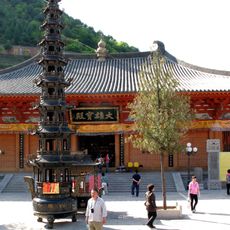
Dailuoding is a Buddhist temple on Mount Wutai with five main buildings arranged along a central axis: the Paifang gate, the Hall of the Four Heavenly Kings, the Danchan Hall, the Manjushri Hall, and the Mahavira Hall. These structures form a clear architectural sequence that guides visitors from the entrance toward the inner sanctuaries.
The temple was originally founded as Foding'an during the Tang Dynasty and received its current name Dailuoding in 1750 under the Qianlong Emperor of the Qing Dynasty. This renaming marked a period of redesign and consolidation under Qing rule.
The five statues in the Manjushri Hall combine the five Manjushri forms worshipped on Mount Wutai's five peaks: Smart Manjushri of the East Peak, Lion's Roar of the West, Wisdom of the South, Stainless of the North and Child of the Centre. Pilgrims call a visit here a "small pilgrimage to the five peaks" (小朝台). A stele before the hall records a poem by the Qianlong Emperor, who came in 1750.
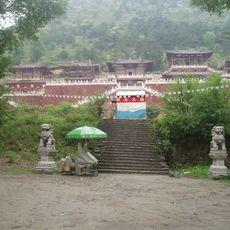
The climb gains 400 metres of height. The southern Dazhi Road, built in 1991 with donations from Master Kaizheng of Hongfa Temple in Kaohsiung, has 1,080 bluestone steps and is short but steep. The northern old path is longer and gentler; a cable car, built in August 1995, runs alongside for a fee.
The Mahavira Hall displays eighteen Arhat statues flanking the central figures of Sakyamuni, Amitabha, and Bhaisajyaguru. This arrangement shows how different strands of Buddhist teaching are symbolized through the placement and attributes of these figures.
The community of curious travelers
AroundUs brings together thousands of curated places, local tips, and hidden gems, enriched daily by 94,356 contributors worldwide.