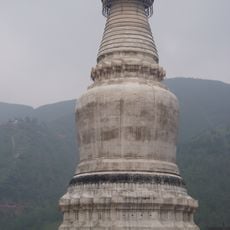
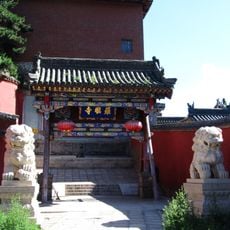
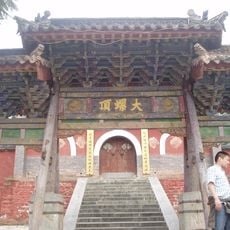
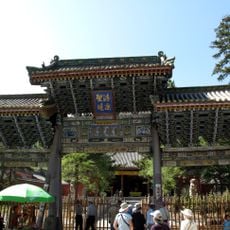
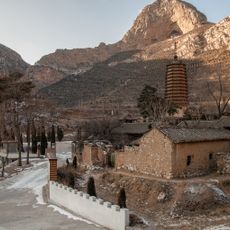
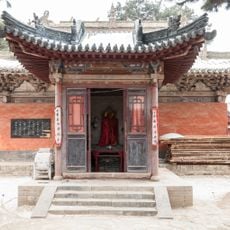
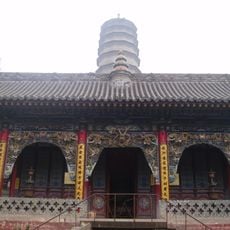
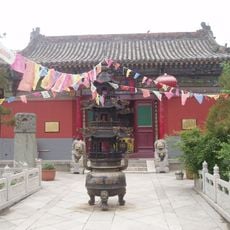
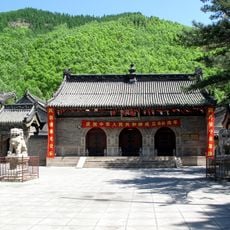
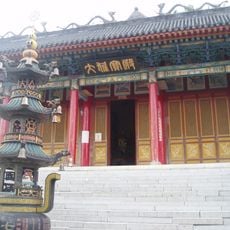
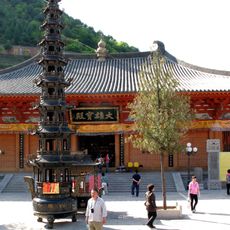
Xiantong Temple, Buddhist temple in Wutai County, China.
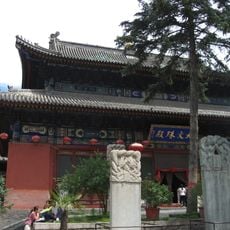
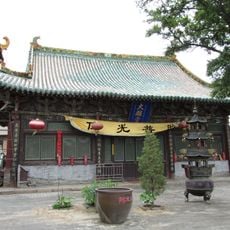
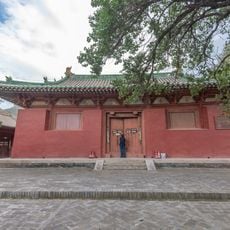
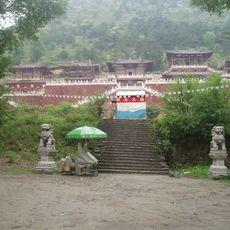
Xiantong Temple covers about 80,000 square metres in Taihuai Town and keeps the Ming and Qing architectural pattern, with over 400 buildings. Seven main halls stand on the central axis: Guanyin Hall, Great Manjusri Hall, Great Buddha Hall, Wuliang Hall, Qianbo Hall, Copper Hall and the Buddhist Texts Library. The Great Buddha Hall, rebuilt in 1899, is nine bays wide and the largest hall on Mount Wutai.
Founded in 68 AD during the Yongping era of the Eastern Han, Xiantong Temple began as Dafu Lingjiu Temple, named for Mount Wutai's resemblance to Vulture Peak. It was expanded as Huayuan Temple under the Northern Wei, rebuilt as Great Huayan Temple under Emperor Taizong of Tang, and renamed Great Xiantong Temple in the Ming Hongwu period. In 1687 the Kangxi Emperor restored the name Great Xiantong Temple.
The temple's name changed with imperial favour: Dafu Lingjiu under the Eastern Han, Huayuan under the Northern Wei, Great Huayan under the Tang, and Great Xiantong from 1687 under the Kangxi Emperor. The bell outside the gate is called the Long Toll Bell, or Longevity Bell, because the two phrases sound alike in Chinese. Look for the Tang stone slabs flanking the gate, carved with a dragon and a tiger.
The site is best explored on foot, and visitors need time to see all the areas throughout the complex. Comfortable shoes and drinking water are important since the terrain is hilly and can be physically demanding.
A standout feature within the complex is a large metal hall decorated with fine carvings, representing an extraordinary achievement in craftsmanship from the early 17th century. This hall demonstrates the advanced technical skills that existed during that era of Chinese history.
The community of curious travelers
AroundUs brings together thousands of curated places, local tips, and hidden gems, enriched daily by 93,839 contributors worldwide.