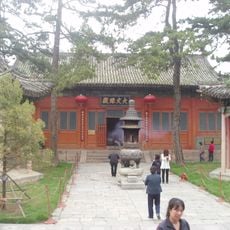
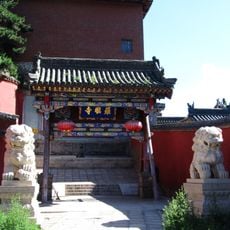
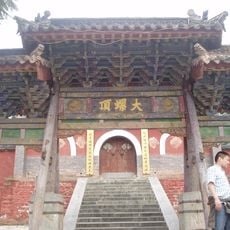
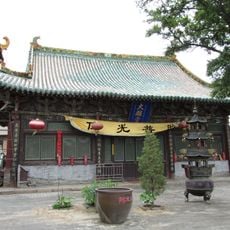
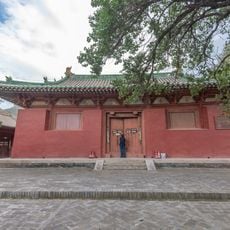
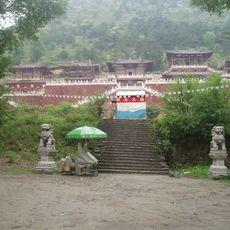
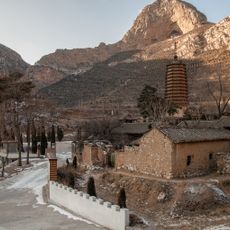
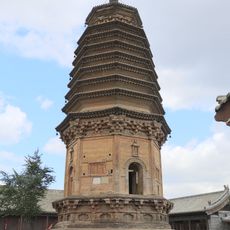
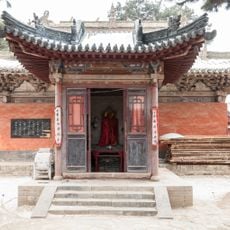
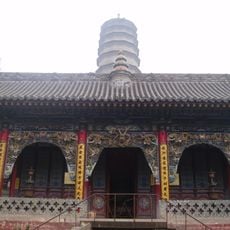
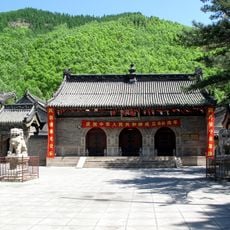
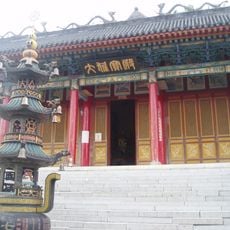
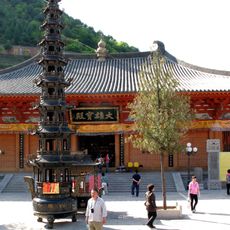
Bishan Temple, Buddhist temple in Taihuai Town, Wutai County, China.
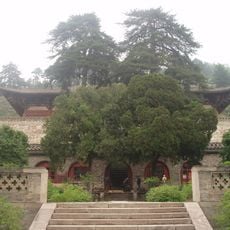
Bishan Temple is a Buddhist sanctuary in Taihuai comprising several main halls, each serving specific religious functions. The grounds include a library of religious texts and features a decorative stone wall with carved inscriptions from earlier periods.
Founded under Emperor Xiaowen of Northern Wei (467–499) as Beishan Temple, it was rebuilt in the Ming dynasty and renamed Puji Temple under Emperor Yingzong. The Qianlong Emperor gave it the name Bishan Temple because mountains surround it, and in the Xuantong reign it also became known as Guangji Maopeng. In 1983 it was listed among the National Key Buddhist Temples in Han Chinese Area.
The temple's name shifts with its history: Beishan, Puji, then Bishan under the Qianlong Emperor, and Guangji Maopeng in the Xuantong reign. Its reputation grew because it lodged traveling monks free of charge, chose abbots by merit, and barred the disciples of its own masters from residing there. In the Republic era, the monks Xuyun, Yuanying and Yinguang preached here.
The temple lies in Taihuai Town, Wutai County, with its main halls arranged along a central axis: Tianwang Dian, Leiyin Baodian, Jietan Hall and Zangjing Ge. The ordination altar in Jietan Hall is made of bluestone and measures 5.1 metres long, 5 metres wide and 1.2 metres high. Visitors can walk between the halls on level ground; no steep hillside stairs are involved.
A remarkable bronze statue of Sakyamuni was brought here from Burma in 1928 and remains venerated in one of the halls. This makes the temple an uncommon example of international religious connections in the region.
The community of curious travelers
AroundUs brings together thousands of curated places, local tips, and hidden gems, enriched daily by 93,484 contributors worldwide.