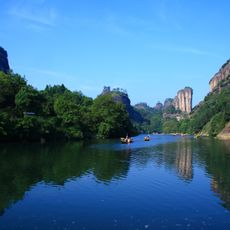
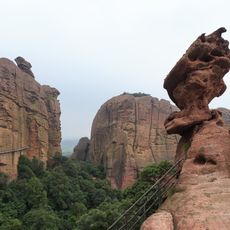
Wuyishan cliff tombs, Ancient burial chambers in Wuyishan, China.
The Wuyishan cliff tombs comprise multiple chambers carved directly into the rock faces alongside the Jiuqu River gorge in Fujian Province. The chambers are positioned at varying heights along the cliffside and feature detailed carved patterns and stone work.
The cliff burials were practised by the ancient Min people of Wuyishan during the Bronze Age, and 18 sites with more than 20 boat coffins survive along the Jiuqu River and in the Beishan area. In 1973 and 1978 coffins were removed from Guanyinyan and Baiyan; the Baiyan coffin, 4.89 m long and cut from a single log, dates by carbon-14 to about 3750–3295 years ago. The tombs were listed as a Fujian provincial site in 1985 and as a national key cultural site in 2006.
Ancient visitors saw the coffins high on the cliffs and, unable to reach them, called them xianchuan (immortal boats) or xianhan, taking them for traces of immortals. The tombs belong to the ancient Min people, who practiced this burial custom during the Bronze Age, as did communities across southern China and Southeast Asia.
You can reach the tombs using marked trails throughout the Wuyishan scenic area, where guided tours are available to help interpret the site. Wear sturdy footwear since some paths climb steeply and certain areas require careful footing on uneven stone surfaces.
The boat coffin removed from Baiyan in 1978 lay 51 meters above the valley floor and measures 4.89 meters long, 0.55 meters wide and 0.73 meters high. Carved from a single log with a separate lid, it still held bones, bamboo mats, a turtle-footed wooden tray and carbonized silk, cotton and hemp cloth. Carbon-14 dating places the wood at about 3750–3295 years old.
The community of curious travelers
AroundUs brings together thousands of curated places, local tips, and hidden gems, enriched daily by 93,923 contributors worldwide.