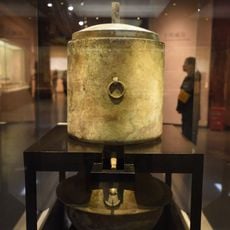
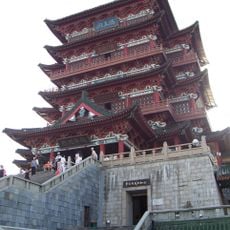
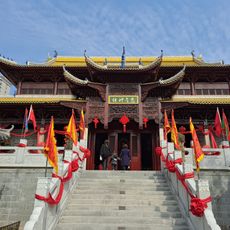
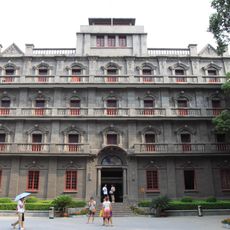
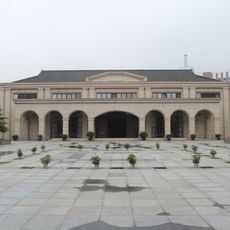
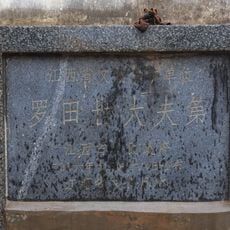
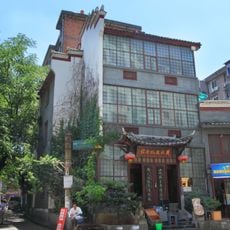
Jiangxi Sheng bo wu guan, Provincial museum in Nanchang, China.
The Jiangxi Provincial Museum is a comprehensive museum on the north bank of the Gan River in Honggutan District, Nanchang. Its new building, one of the three halls of the Jiangxi Cultural Centre, takes a square box as its architectural prototype, meant to suggest a treasure box. It has six floors, a floor area of 86,000 square metres and 28,000 square metres of exhibition space.
The museum traces its origin to the Jiangxi Science Museum; a preparatory office was set up in March 1953, and the first exhibition hall opened at the south end of Bayi Square on 1 July 1961. In 1978 it was renamed the Jiangxi History Museum, and in 1981 it merged with the Jiangxi Revolution Museum under the name Jiangxi Provincial Museum. A new building on Xinzhou Road opened on 1 October 1999, and the current Honggutan branch opened on 27 September 2020.
The exhibition displays traditional crafts and local customs that shaped Jiangxi society over centuries. You can observe how these practices remain present in the region and continue to influence how people live today.
The new building in Honggutan District has six floors, with 28,000 square metres of exhibition space inside a total floor area of 86,000 square metres. Start from the top floor and work downward to cover the halls in order. The site lies on the north bank of the Gan River, at 698 Ganjiang North Avenue.
The museum presents rotating exhibitions of works by the painter Qi Baishi, including pieces called Red Flowers and Black Leaves in collaboration with another provincial institution. These special presentations bring together paintings that are otherwise scattered across different locations.
The community of curious travelers
AroundUs brings together thousands of curated places, local tips, and hidden gems, enriched daily by 95,440 contributors worldwide.