New Qiantang River Railway Bridge, bridge in People's Republic of China
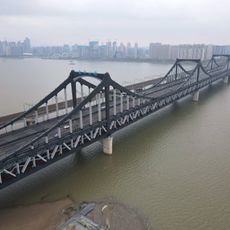
The New Qiantang River Railway Bridge, also called the Tenth Qiantang River Bridge, is a four-track railway bridge over the Qiantang River in Hangzhou, running parallel to and 20.9 metres upstream of the Qianjiang Second Bridge. Its main span is 1,340 metres long within a total length of 2,222.22 metres, and its deck carries the Shanghai-Kunming and Hangzhou-Ningbo high-speed railways.
Construction began in December 2007 and the bridge was joined in 2010; it opened on 1 July 2013 with only the Shanghai-Kunming pair of tracks in use, limited to 160 km/h. In late October 2014 the speed rose to 200 km/h as the Hangzhou-Changsha high-speed line neared completion. From 10 January 2016 the third and fourth Hangzhou East-Hangzhou South tracks opened, and nearly 50 pairs of trains were rerouted over the bridge.
The bridge is known locally as the Qianjiang No. 10 Bridge, counting from the first Qiantang River crossing. It carries the Shanghai-Kunming and Hangzhou-Ningbo high-speed lines, and since 2016 nearly 50 pairs of trains have been rerouted onto it. Its opening raised the number of railway tracks crossing the Qiantang from three to seven.
The bridge runs parallel to the Qianjiang Second Bridge, only 20.9 metres upstream, so both spans can be seen from the same riverside spot. It links Hangzhou East Station in the north with Hangzhou South Station in the south. Trains cross at up to 200 km/h, and since January 2016 nearly 50 pairs of trains a day have used the Hangzhou-Ningbo line over it.
The bridge stands only 20.9 metres upstream of the Qianjiang Second Bridge, so the two crossings run almost side by side over the water. Its opening raised the number of railway tracks crossing the Qiantang from three to seven, since the First Bridge carries a single line and the Second Bridge two shared passenger and freight lines.
The community of curious travelers
AroundUs brings together thousands of curated places, local tips, and hidden gems, enriched daily by 94,294 contributors worldwide.