Haichao Temple, Buddhist temple in Shangcheng District, China.
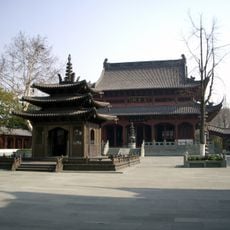
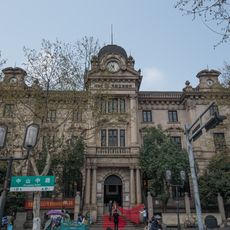
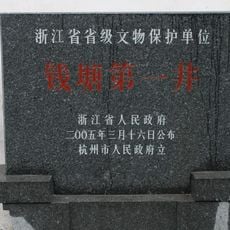
Haichao Temple is a Buddhist temple in Shangcheng District, Hangzhou, of which only the Hall of Four Heavenly Kings remains. Built in 1890, the hall has five bays across and four deep, with a double-eaved hip-and-gable roof. A beam inscription records its repair in the tenth month of 1890, and the grounds also hold the Shuangzhao Well and an old camphor tree.
Haichao Temple was first built during the Wanli period (1573–1620) of the Ming dynasty and was counted among the Four Buddhist Temples of Hangzhou. It was badly damaged in the Taiping Rebellion in 1861, rebuilt from 1864, and in 1881 abbot Puzhao added a Buddhist Texts Library to house a canon granted by the Guangxu Emperor. From 1937 it served as the First Provisional Assistant Hospital of Zhejiang Province, and in 1958 it became a rubber plant.
The name Haichao means "sea tide": the temple stood by the Qiantang River estuary, where monks heard the tide come in at night and go out at dawn. It was counted among the Four Buddhist Temples of Hangzhou, with Lingyin, Jing and Zhaoqing temples. The surviving Hall of Four Heavenly Kings keeps a beam inscription dated the tenth month of 1890.
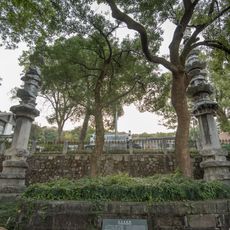
The temple site lies outside Wangjiang Gate in Shangcheng District, about 1.5 km from the Qiantang River; the old river embankment is today's Qiutao Road. Only the Hall of Four Heavenly Kings, the Shuangzhao wells and an old camphor tree remain, so allow a short visit. The hall was listed as a municipal cultural relic in July 2000, and reconstruction on the original site is planned.
Inside the temple stands a historical collection of Buddhist texts gathered by an important abbot over time. This library reveals the scholarly tradition that the monastery maintained across generations.
The community of curious travelers
AroundUs brings together thousands of curated places, local tips, and hidden gems, enriched daily by 93,467 contributors worldwide.